
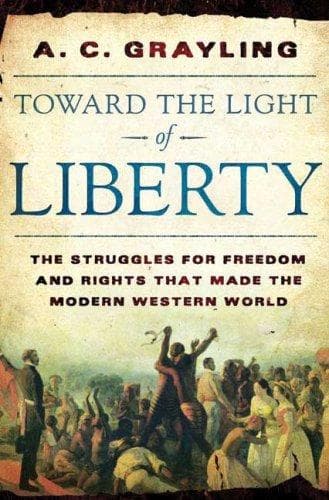
Towards the Light: The Story of the Struggles for Liberty and Rights That Made the Modern West
نحو النور: قصة الكفاح من أجل الحرية والحقوق التي صنعت الغرب الحديث
Vers la Lumière : L'Histoire des Luttes pour la Liberté et les Droits qui ont Fait l'Occident Moderne
Editorial summary
Anthony Grayling's Towards the Light presents a sweeping historical narrative that traces the development of liberty, individual rights, and secular governance in Western civilization from the Reformation to the present day. The work functions as both a historical survey and a philosophical argument about the relationship between religious authority and human freedom, with significant implications for debates about God's role in moral and political life.
Grayling constructs his argument through a chronological examination of key intellectual and political movements that challenged religious hegemony over knowledge, morality, and governance. He analyzes the Reformation's unintended consequences in fracturing religious unity, the scientific revolution's displacement of theological explanations, the Enlightenment's elevation of reason over revelation, and the gradual emergence of democratic institutions based on secular principles. The author pays particular attention to pivotal figures such as Galileo, Voltaire, Kant, and Mill, demonstrating how their contributions progressively diminished the Church's authority over intellectual and political life.
The work's central thesis contends that human progress toward liberty and rights has occurred precisely through the rejection of theocratic authority and divine command theories of morality. Grayling argues that appeals to God as the foundation for ethics and governance have historically served to justify oppression, censorship, and the denial of basic freedoms. He presents the development of secular humanism not as a loss of moral foundation but as humanity's maturation beyond the need for supernatural validation of ethical principles.
Methodologically, Grayling employs intellectual history to support his philosophical position, drawing connections between the decline of religious authority and the expansion of human rights, scientific progress, and democratic governance. His approach combines historical analysis with normative arguments about the superiority of secular over religious foundations for morality and politics.
The work stands as a significant contribution to debates about secularization and the God hypothesis, particularly in its challenge to claims that Western values depend upon Christian foundations. Grayling's narrative directly opposes theologians and religious philosophers who argue that human rights and moral progress require divine grounding. His historical account serves a broader philosophical purpose: demonstrating that humanity's greatest achievements in expanding freedom and knowledge have come through abandoning rather than embracing religious authority. This positions the work as both a historical study and a philosophical argument against the necessity or desirability of God-centered worldviews in modern society.
Argument formulations engaged
Grayling, A. C. (2007). Towards the Light: The Story of the Struggles for Liberty and Rights That Made the Modern West. Bloomsbury.
@book{towards-the-light-the-story-of-the-strug,
  author    = {Grayling, A. C.},
  title     = {Towards the Light: The Story of the Struggles for Liberty and Rights That Made the Modern West},
  year      = {2007},
  publisher = {Bloomsbury},
  url       = {https://god-database.com/en/works/towards-the-light-the-story-of-the-struggles-for-liberty-and-rights-that-made-the-modern-west-2007}
}