
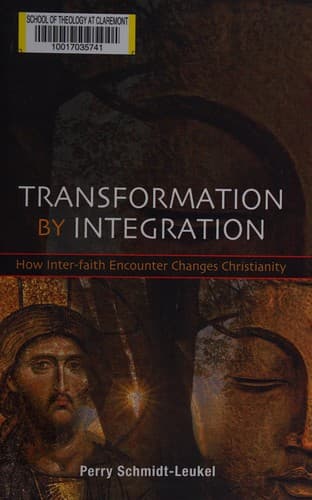
Transformation by Integration
التحول بالتكامل
Transformation par Intégration
Editorial summary
This monograph advances a pluralist theology of religions through the lens of "transformation by integration," proposing that religious traditions can undergo profound renewal by incorporating insights from other faiths without losing their distinctive identities. Schmidt-Leukel challenges both exclusivist claims to religious superiority and relativist approaches that minimize substantive differences between traditions, offering instead a model of inter-religious learning that maintains theological integrity while embracing genuine openness to the other.
The work develops a sophisticated framework for understanding how religions evolve through encounter and dialogue. Schmidt-Leukel argues that when religious traditions engage seriously with the truth claims and spiritual insights of other faiths, they do not merely add external elements but undergo internal transformation that enriches their own self-understanding. This process, which he terms "integration," involves reinterpreting one's own tradition in light of discoveries made through inter-religious encounter, leading to new theological possibilities previously unimagined within a single tradition's resources.
Central to Schmidt-Leukel's argument is the claim that ultimate reality—whether conceived as God, Brahman, or the Dharma—transcends any single religious articulation while being authentically present in multiple traditions. This position directly challenges traditional Christian exclusivism and inclusivism, which either deny salvific efficacy to other religions or subordinate them to Christianity's supposedly superior revelation. Instead, Schmidt-Leukel proposes that different religions offer complementary perspectives on the divine that, when brought into dialogue, can generate fuller understanding than any tradition possesses in isolation.
The monograph engages critically with major figures in theology of religions, particularly John Hick's pluralist hypothesis and S. Mark Heim's orientational pluralism. While building on Hick's insights about the Real manifesting through various religious forms, Schmidt-Leukel develops a more nuanced account of how traditions maintain their particularity while participating in shared truth. Against Heim's acceptance of irreducibly different religious ends, he argues for an underlying unity of ultimate reality that makes inter-religious learning both possible and necessary.
Schmidt-Leukel's contribution lies in demonstrating how pluralist theology need not dissolve into relativism or syncretism. By carefully analyzing examples of transformation through Buddhist-Christian dialogue and Hindu-Christian encounter, he shows how integration preserves what is valuable in each tradition while generating new insights about the nature of ultimate reality. This work significantly advances debates about religious diversity and the possibility of maintaining robust faith commitments in a pluralistic context.
Argument formulations engaged
Schmidt-Leukel, Perry (2017). Transformation by Integration.
@book{transformation-by-integration-2017,
  author    = {Schmidt-Leukel, Perry},
  title     = {Transformation by Integration},
  year      = {2017},
  url       = {https://god-database.com/en/works/transformation-by-integration-2017}
}