
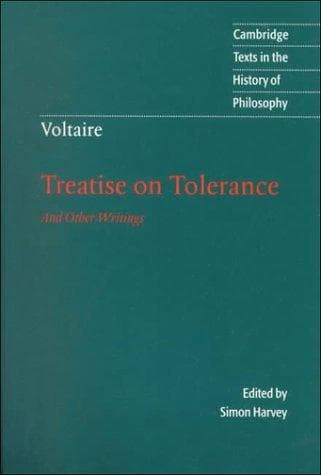
Editorial summary
This seminal work emerges from the controversial Jean Calas affair, in which a Protestant merchant was executed on spurious charges of murdering his son to prevent conversion to Catholicism. Voltaire transforms this miscarriage of justice into a broader philosophical meditation on religious intolerance and its devastating social consequences. The treatise systematically dismantles theological justifications for persecution while advancing a pragmatic argument for religious pluralism grounded in natural law and social utility.
Voltaire constructs his argument through historical analysis, demonstrating how religious fanaticism has repeatedly produced violence and social disorder throughout human history. He examines cases from ancient Rome through contemporary Europe, showing that tolerance rather than persecution has consistently proven more conducive to political stability and human flourishing. The work particularly targets the Catholic Church's claims to exclusive truth and its historical use of coercion to enforce orthodoxy, though Voltaire extends his critique to all forms of religious extremism.
The philosophical core of the treatise rests on a minimalist natural religion accessible through reason. Voltaire argues that while humans may disagree about theological minutiae, all can recognize a supreme being through rational reflection on the natural order. This common ground should foster mutual tolerance rather than persecution over doctrinal differences. He distinguishes between private religious conviction, which deserves protection, and public religious authority, which threatens civil peace when it claims temporal power.
Voltaire's method combines Enlightenment rationalism with rhetorical passion, using irony and moral outrage to expose the absurdity of killing in God's name. He deploys comparative religion to relativize Christian claims to exclusive truth, noting similar moral teachings across diverse traditions. The work reflects the broader deist movement of the eighteenth century, which sought to preserve belief in God while stripping away what philosophes viewed as superstitious accretions.
The treatise's enduring significance lies in its articulation of religious tolerance as both a moral imperative and political necessity. Voltaire's argument that diversity of belief need not threaten social cohesion became foundational for liberal political theory. While maintaining belief in a divine creator, he effectively challenges religious institutions' claims to enforce orthodoxy through state power. The work thus represents a crucial moment in the secularization of political authority and the emergence of modern pluralistic societies.
Argument formulations engaged
Voltaire (1763). Treatise on Tolerance.
@book{treatise-on-tolerance-1763,
  author    = {Voltaire},
  title     = {Treatise on Tolerance},
  year      = {1763},
  url       = {https://god-database.com/en/works/treatise-on-tolerance-1763}
}