
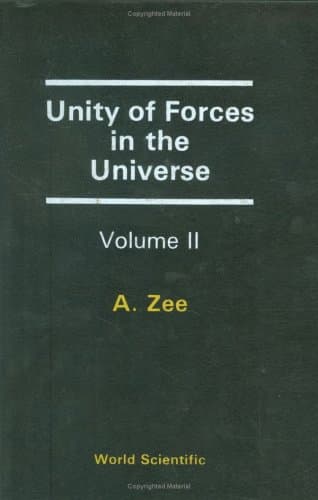
Unity of Forces in the Universe
وحدة القوى في الكون
L'Unité des forces dans l'univers
The convergence of fundamental physical forces toward a single unified framework suggests a deep mathematical order in nature that carries philosophical and potentially theological implications.
Editorial summary
This monograph examines the profound implications of unified field theory for understanding cosmic order and design. Zee presents a sophisticated analysis of how the progressive unification of fundamental forces reveals an underlying mathematical elegance that poses significant questions for philosophy of science and natural theology. The work navigates between scientific exposition and philosophical reflection, addressing how discoveries in theoretical physics bear on traditional arguments about cosmic design without advocating for any particular metaphysical conclusion.
The text traces the historical development from Maxwell's unification of electricity and magnetism through electroweak theory to contemporary attempts at grand unification. Zee demonstrates how each successive unification reveals greater simplicity beneath apparent complexity, suggesting that nature's fundamental laws possess an aesthetic economy that demands explanation. This mathematical beauty, he argues, transcends mere human projection and appears intrinsic to physical reality itself. The author carefully analyzes how symmetry principles and group theory provide the mathematical framework for understanding force unification, making these technical concepts accessible while preserving their philosophical significance.
Central to Zee's analysis is the relationship between unification and fine-tuning. He explores how unified theories reveal precise numerical relationships between fundamental constants that appear calibrated for complexity and life. The work engages critically with both design arguments that interpret this precision as evidence of purpose and naturalistic explanations that invoke selection effects or multiple universes. Zee maintains that while unification strengthens the case for cosmic order, it does not definitively resolve the question of ultimate explanation.
The monograph's distinctive contribution lies in its balanced treatment of how cutting-edge physics intersects with perennial philosophical questions. Zee avoids both the reductionism that dismisses design questions as meaningless and the hasty theological appropriation of scientific discoveries. Instead, he develops a nuanced position that acknowledges the genuine puzzles posed by nature's mathematical structure while recognizing the limitations of purely scientific explanation. His analysis of how aesthetic criteria guide theory selection in physics provides fresh perspective on the relationship between human cognition and cosmic order.
This work significantly advances discussions of design and fine-tuning by grounding philosophical speculation in rigorous understanding of contemporary physics. Zee's careful attention to both scientific detail and philosophical implications establishes a model for productive dialogue between physics and philosophy of science on questions of ultimate explanation.
Structured analysis
Argument formulations engaged
Zee, Anthony (1982). Unity of Forces in the Universe. World Scientific Pub Co Inc.
@book{unity-of-forces-in-the-universe,
  author    = {Zee, Anthony},
  title     = {Unity of Forces in the Universe},
  year      = {1982},
  publisher = {World Scientific Pub Co Inc},
  url       = {https://god-database.com/en/works/unity-of-forces-in-the-universe}
}