
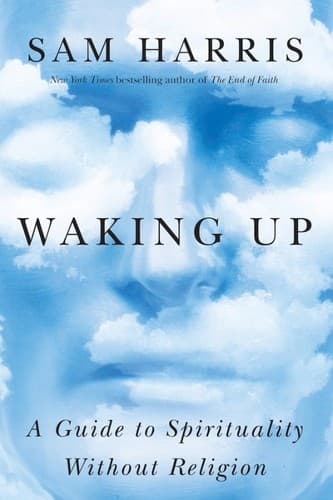
Waking Up: A Guide to Spirituality Without Religion
الاستيقاظ: دليل إلى الروحانية بدون دين
Se réveiller : Un guide vers la spiritualité sans religion
Editorial summary
Sam Harris's "Waking Up: A Guide to Spirituality Without Religion" presents a systematic argument for preserving contemplative practices while rejecting their traditional religious frameworks. The work represents a significant intervention in contemporary debates about consciousness, spirituality, and the nature of religious experience, particularly from within the New Atheist movement of which Harris has been a prominent voice.
Harris develops his central thesis through a synthesis of neuroscientific research, Buddhist meditation theory, and phenomenological analysis of consciousness. He argues that spiritual experiences—understood as profound alterations in consciousness that reveal the illusory nature of the self—constitute genuine and valuable human experiences that can be entirely divorced from supernatural beliefs. The work directly challenges both traditional religious accounts that interpret these experiences as evidence for God or the divine, and reductive materialist positions that dismiss such experiences as mere delusion.
The monograph's methodological approach combines empirical neuroscience with introspective practices drawn primarily from Dzogchen and Vipassana Buddhist traditions. Harris employs his own extensive meditation experience alongside scientific studies of contemplative practices to demonstrate how spiritual experiences can be naturalized within a materialist worldview. He particularly emphasizes how meditation reveals the constructed nature of selfhood, arguing this insight undermines dualistic religious frameworks that posit souls or divine consciousness.
Harris positions his work against two primary opponents: religious traditionalists who claim exclusive ownership of spiritual experience, and secular skeptics who reject any engagement with contemplative practices as inherently religious. His argument represents an attempt to reclaim spirituality for secular philosophy, proposing that atheists need not abandon the experiential dimensions of human consciousness that religions have historically cultivated.
The significance of this work lies in its potential to reshape debates about religious experience and consciousness. By arguing that the most profound aspects of spiritual practice can be preserved within a naturalistic framework, Harris challenges conventional boundaries between religious and secular approaches to human flourishing. His work suggests that rejecting belief in God need not entail rejecting practices aimed at transcendent experience or self-transformation. This position has proven influential in contemporary discussions about secular Buddhism, mindfulness practices, and the relationship between neuroscience and contemplative traditions, while also drawing criticism from both religious practitioners who view it as reductionist and philosophers who question his interpretation of consciousness and selfhood.
Argument formulations engaged
Related works
Harris, Sam (2014). Waking Up: A Guide to Spirituality Without Religion. Simon & Schuster.
@book{waking-up-a-guide-to-spirituality-withou,
  author    = {Harris, Sam},
  title     = {Waking Up: A Guide to Spirituality Without Religion},
  year      = {2014},
  publisher = {Simon & Schuster},
  url       = {https://god-database.com/en/works/waking-up-a-guide-to-spirituality-without-religion-2014}
}