
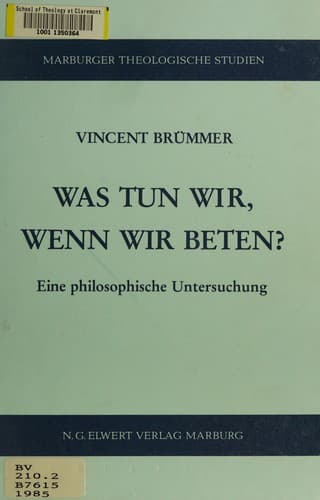
What Are We Doing When We Pray?
ماذا نفعل عندما نصلي؟
Que Faisons-Nous Quand Nous Prions ?
Editorial summary
Vincent Brümmer's "What Are We Doing When We Pray?" undertakes a rigorous philosophical analysis of petitionary prayer, challenging both traditional theological accounts and contemporary philosophical critiques. The work represents a significant intervention in the philosophy of religion by arguing that prayer, properly understood, constitutes a coherent practice within a theistic framework that conceives of God as personal.
Brümmer develops his argument through careful conceptual analysis, drawing on speech act theory and the philosophy of action to illuminate the logic of prayer. He contends that petitionary prayer should be understood not as an attempt to change God's mind or inform an omniscient deity, but as a form of personal address that establishes and maintains a relationship between the pray-er and God. This relational model stands in opposition to both mechanistic views of prayer as magical causation and reductionist accounts that treat prayer merely as psychological self-help.
The monograph engages critically with several philosophical traditions. Against logical positivists who dismiss religious language as meaningless, Brümmer demonstrates that prayer employs a distinctive but intelligible form of discourse. He also challenges process theologians who limit divine responsiveness to preserve human freedom, arguing instead for a model of divine-human interaction that maintains both divine sovereignty and genuine human agency. His analysis particularly targets the incoherence objection raised by philosophers who argue that petitionary prayer is incompatible with divine attributes such as omniscience and immutability.
Central to Brümmer's contribution is his distinction between imperative and optative forms of petition, showing how prayer can express desires and requests without presuming to command God. He develops a sophisticated account of how divine action in response to prayer need not violate natural laws or compromise human freedom, drawing on analogies with interpersonal communication and influence.
The work's significance lies in its demonstration that petitionary prayer admits of philosophical defense without abandoning traditional theistic commitments. By treating prayer as a form of dialogue within a personal relationship, Brümmer provides resources for understanding religious practice that avoid both crude anthropomorphism and abstract philosophical theism. His careful attention to the phenomenology of prayer while maintaining philosophical rigor establishes a framework that has influenced subsequent discussions in both analytic philosophy of religion and theological reflection on spiritual practices.
Argument formulations engaged
Brummer, Vincent (1984). What Are We Doing When We Pray?. Ashgate Publishing, Ltd..
@book{what-are-we-doing-when-we-pray-1984,
  author    = {Brummer, Vincent},
  title     = {What Are We Doing When We Pray?},
  year      = {1984},
  publisher = {Ashgate Publishing, Ltd.},
  url       = {https://god-database.com/en/works/what-are-we-doing-when-we-pray-1984}
}