
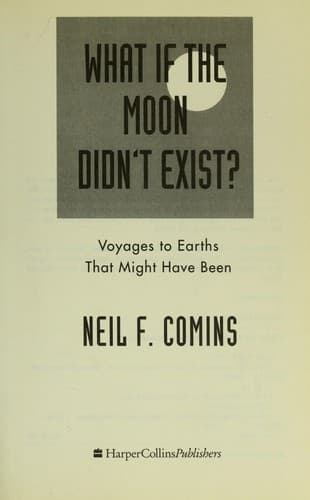
What If the Moon Didn't Exist?: Voyages to Earths That Might Have Been
ماذا لو لم يكن القمر موجوداً؟: رحلات إلى أراضٍ كان يمكن أن تكون
Et Si la Lune N'Existait Pas ? : Voyages vers des Terres qui Auraient Pu Être
Editorial summary
This volume explores how Earth's evolution and the development of life would have differed under alternative astronomical conditions, offering a unique perspective on the fine-tuning argument often employed in discussions about cosmic design and divine purpose. Comins, an astronomer, constructs ten counterfactual scenarios examining how changes in celestial mechanics would have produced radically different planetary outcomes. The titular chapter investigates an Earth without its moon, demonstrating how the absence of lunar tidal forces would have resulted in shorter days, altered weather patterns, and potentially prevented the emergence of complex life forms.
The work systematically examines variations including closer or more distant suns, different planetary tilts, alternative stellar companions, and modified orbital configurations. Each scenario receives rigorous scientific treatment, with Comins calculating the cascading effects through atmospheric composition, ocean dynamics, geological processes, and biological evolution. His analysis reveals the extraordinary sensitivity of Earth's habitability to precise astronomical parameters. A planet orbiting closer to the sun would experience runaway greenhouse effects; one tilted differently would suffer extreme seasonal variations incompatible with stable ecosystems. The author demonstrates how seemingly minor alterations in initial conditions produce dramatically divergent outcomes.
While Comins maintains a strictly scientific approach without explicit theological commentary, his work provides substantial material for natural theology debates. The book illuminates the remarkable convergence of factors required for Earth to support intelligent life, lending itself to interpretations supporting both design arguments and anthropic principle discussions. Theistic readers may find evidence for purposeful creation in the precise calibration of cosmic variables, while naturalistic interpreters might emphasize the selection effects inherent in observers necessarily finding themselves in habitable universes.
The monograph's contribution lies in its detailed scientific exposition of cosmic fine-tuning, moving beyond abstract philosophical arguments to concrete astronomical and geological analysis. By quantifying how different astronomical configurations would preclude life as we know it, Comins provides empirical grounding for discussions about whether the universe's life-permitting properties reflect design, necessity, or chance. His accessible yet scientifically rigorous approach makes complex astrophysical concepts comprehensible to non-specialists, enriching public discourse on science and ultimate questions. The work serves as a valuable resource for philosophers, theologians, and scientists engaged in examining the implications of cosmic fine-tuning for arguments about purpose, design, and the existence of God.
Argument formulations engaged
Comins, Neil (1993). What If the Moon Didn't Exist?: Voyages to Earths That Might Have Been.
@book{what-if-the-moon-didnt-exist-voyages-to-,
  author    = {Comins, Neil},
  title     = {What If the Moon Didn't Exist?: Voyages to Earths That Might Have Been},
  year      = {1993},
  url       = {https://god-database.com/en/works/what-if-the-moon-didnt-exist-voyages-to-earths-that-might-have-been-1993}
}