
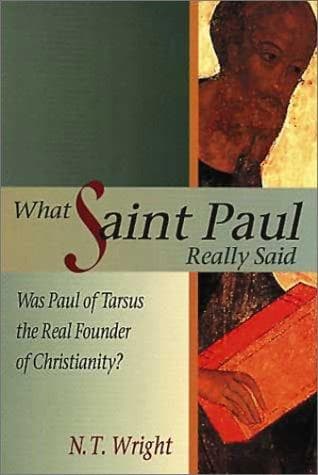
What Saint Paul Really Said
ما قاله القديس بولس حقاً
Ce que saint Paul a vraiment dit
Editorial summary
This monograph presents a comprehensive reassessment of Pauline theology that challenges both traditional Protestant readings and contemporary scholarly interpretations. Wright argues that the apostle Paul's central message has been fundamentally misunderstood through centuries of theological interpretation, particularly regarding justification, the relationship between Judaism and Christianity, and the nature of the gospel itself.
The work directly confronts the Lutheran-Reformed tradition's reading of Paul, which Wright contends has imposed sixteenth-century controversies onto first-century texts. Against the view that Paul primarily opposed Jewish legalism or works-righteousness, Wright demonstrates that Paul's critique of Judaism centered on its ethnic exclusivity rather than any inherent theological deficiency. This reframing significantly impacts understanding of Paul's theology, particularly his conception of God's covenant faithfulness and the inclusion of Gentiles within the people of God.
Wright's methodology combines historical-critical analysis with theological interpretation, situating Paul firmly within Second Temple Judaism while maintaining the text's contemporary relevance. He argues that Paul's gospel announcement concerns the lordship of Jesus Christ and God's fulfillment of covenant promises to Abraham, rather than primarily addressing individual salvation from guilt. This perspective reconfigures traditional debates about justification by faith, presenting it as God's declaration that believers belong to the covenant family rather than as the means of entering that family.
The monograph's significance for discussions about God lies in its portrayal of divine action through Israel's messiah. Wright presents Paul's God as the covenant-keeping deity who remains faithful to creation and to Israel, acting decisively through Jesus to restore both. This challenges deistic conceptions of divine non-involvement and gnostic tendencies that separate creation from redemption. The work emphasizes God's sovereignty exercised through the crucified and risen messiah, offering a thoroughly Jewish yet universally applicable understanding of divine purpose.
Wright's contribution reshapes fundamental questions about how God relates to humanity, the nature of divine righteousness, and the relationship between divine grace and human response. By recovering what he argues is Paul's authentic voice, Wright provides fresh perspectives on perennial theological debates while maintaining dialogue with both traditional Christianity and critical scholarship. His work demonstrates how historical investigation can illuminate rather than undermine theological conviction.
Argument formulations engaged
Related works
Wright, N. T. (1997). What Saint Paul Really Said. Lion / Eerdmans.
@book{what-saint-paul-really-said-1997,
  author    = {Wright, N. T.},
  title     = {What Saint Paul Really Said},
  year      = {1997},
  publisher = {Lion / Eerdmans},
  url       = {https://god-database.com/en/works/what-saint-paul-really-said-1997}
}