
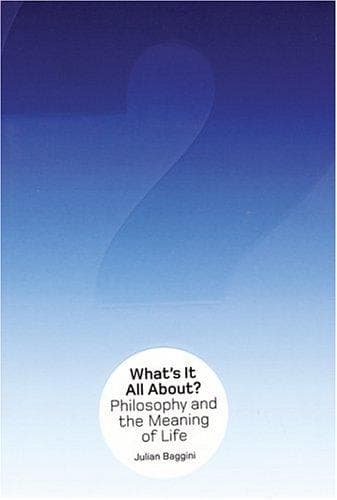
What's It All About? Philosophy and the Meaning of Life
ما هذا كله؟ الفلسفة ومعنى الحياة
De quoi s'agit-il ? Philosophie et le sens de la vie
Editorial summary
Julian Baggini's "What's It All About? Philosophy and the Meaning of Life" (2004) offers a secular philosophical exploration of life's purpose that deliberately sidesteps traditional religious answers. Written for a general audience, the work systematically examines how meaning might be constructed without reference to God or transcendent purpose, positioning itself within the humanistic tradition while engaging critically with theistic frameworks.
Baggini structures his inquiry around six potential sources of meaning: happiness, morality, love, freedom, death, and helping others. His method combines accessible philosophical analysis with careful examination of everyday intuitions about what makes life worthwhile. Throughout, he maintains that the absence of God or cosmic purpose need not render existence meaningless, arguing instead that humans possess the capacity to create authentic meaning through their choices and relationships.
The work directly challenges what Baggini terms "top-down" approaches to meaning—those that derive life's purpose from divine command or metaphysical truths. He contends that such approaches not only lack evidential support but also diminish human agency and responsibility. Against religious philosophers who argue that objective meaning requires God, Baggini develops a "bottom-up" account where meaning emerges from human projects, connections, and values. This positions him against thinkers like William Lane Craig or John Hare who insist that without God, life reduces to absurdity.
Baggini's philosophical approach draws on both analytic and existentialist traditions, showing particular affinity with Thomas Nagel's views on the absurd and Bernard Williams's critique of immortality. He argues that mortality, rather than undermining meaning, actually enables it by creating urgency and finitude that make our choices significant. This reverses traditional theistic arguments that see death as a problem requiring divine solution.
The monograph's significance lies in its systematic defense of secular meaning-making at a popular level. While academic philosophers have long debated these issues, Baggini translates complex arguments into accessible form without sacrificing philosophical rigor. His work provides intellectual resources for those who reject religious worldviews but seek frameworks for purposeful living. By demonstrating how meaning can be rationally constructed without appeal to the divine, Baggini contributes to broader cultural conversations about secularization and the viability of non-religious life philosophies in contemporary society.
Argument formulations engaged
Baggini, Julian (2004). What's It All About? Philosophy and the Meaning of Life. Granta.
@book{whats-it-all-about-philosophy-and-the-me,
  author    = {Baggini, Julian},
  title     = {What's It All About? Philosophy and the Meaning of Life},
  year      = {2004},
  publisher = {Granta},
  url       = {https://god-database.com/en/works/whats-it-all-about-philosophy-and-the-meaning-of-life-2004}
}