
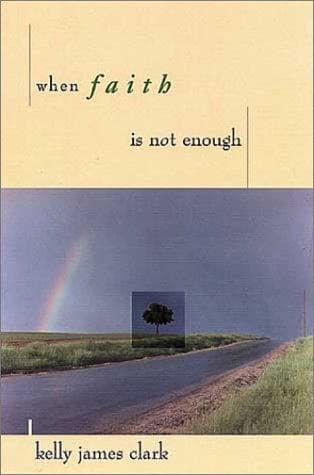
When Faith Is Not Enough
عندما لا يكفي الإيمان
Quand la foi ne suffit pas
Editorial summary
This work examines the intellectual challenges facing religious belief in contemporary philosophy, arguing that traditional approaches to defending faith require substantial revision in light of modern epistemological standards. Clark explores how believers can maintain rational faith when confronted with evidentialist critiques that demand empirical or logical proof for religious claims.
The monograph addresses a fundamental tension in religious epistemology: while many believers experience their faith as certain and compelling, they often cannot provide the kind of evidence that would satisfy philosophical skeptics. Clark analyzes this predicament through engagement with both classical and contemporary debates, examining figures from Aquinas and Calvin to Plantinga and Swinburne. He critiques purely fideistic responses that abandon reason altogether, while also questioning whether the evidentialist framework itself properly captures how rational belief formation actually works.
Central to Clark's argument is the claim that religious belief operates according to different epistemic norms than scientific or mathematical knowledge. He develops a model of "person-relative" rationality, where beliefs can be rational for particular individuals based on their experiences, cognitive frameworks, and epistemic situations, even without universally compelling evidence. This approach draws on Reformed epistemology while addressing its perceived weaknesses, particularly the charge that it licenses arbitrary or wishful thinking.
The work engages critically with natural theology's attempts to prove God's existence through philosophical argument. Clark suggests these projects, while intellectually valuable, miss how actual religious belief typically forms and sustains itself. He examines the role of religious experience, community testimony, and pragmatic considerations in shaping rational religious commitment. The monograph also addresses the problem of religious diversity, exploring how believers can maintain confidence in their particular traditions while acknowledging that equally sincere and intelligent people reach different conclusions.
Clark's contribution lies in charting a middle course between uncritical faith and reductive rationalism. He argues that religious belief can be intellectually responsible without meeting impossibly high evidential standards, while still acknowledging the genuine challenges posed by philosophical critique. The work offers resources for believers struggling with doubt and for philosophers seeking to understand religious rationality on its own terms rather than forcing it into alien epistemological frameworks.
Argument formulations engaged
Clark, Kelly James (1997). When Faith Is Not Enough. Eerdmans.
@book{when-faith-is-not-enough-1997,
  author    = {Clark, Kelly James},
  title     = {When Faith Is Not Enough},
  year      = {1997},
  publisher = {Eerdmans},
  url       = {https://god-database.com/en/works/when-faith-is-not-enough-1997}
}