
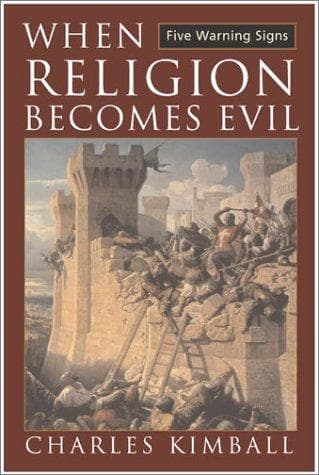
When Religion Becomes Evil
حين يصبح الدين شراً
Quand la religion devient mal
Religion becomes a force for evil when it exhibits identifiable warning signs — absolute truth claims, blind obedience, the establishment of an ideal end, and the dehumanization of the other — that corrupt its own best ideals.
Editorial summary
Charles Kimball's monograph examines the conditions under which religious traditions transform from sources of meaning and community into destructive forces. Drawing on comparative religious studies methodology, Kimball analyzes patterns across Christianity, Islam, Judaism, Hinduism, and Buddhism to identify what he terms the "warning signs" of religious corruption. His work contributes to discussions of the problem of evil by addressing how religions themselves can become vehicles for harm, thus engaging with theodicy from a distinct angle that focuses on human religious behavior rather than divine attributes.
The work identifies five key indicators that signal when religion moves toward dangerous extremes: claims of absolute truth, blind obedience to religious authority, establishment of "ideal" times that must be reclaimed or achieved, belief that ends justify any means, and declaration of holy war. Kimball argues these elements appear across religious traditions when healthy faith becomes pathological. His comparative approach demonstrates how similar patterns emerge in different contexts, from Christian crusades to Islamic extremism, from Hindu nationalism to Buddhist violence in Myanmar.
Kimball's analysis engages critically with exclusivist religious claims while maintaining respect for authentic religious expression. He distinguishes between the core teachings of religious traditions and their distorted manifestations, arguing that violence and oppression represent corruptions rather than authentic expressions of faith. This position allows him to critique religious extremism without dismissing religion itself, positioning his work within a dialogical framework that seeks constructive engagement between religious and secular perspectives.
The monograph's significance lies in its systematic approach to identifying religious pathology across traditions. Rather than attacking religion per se or defending it uncritically, Kimball provides analytical tools for distinguishing healthy from destructive religious expressions. His work implicitly challenges both religious fundamentalists who claim exclusive truth and secular critics who view all religion as inherently problematic. By focusing on observable behaviors and institutional patterns rather than theological claims about divine nature, Kimball reframes the problem of evil discussion around human agency and responsibility within religious systems.
This contribution proves particularly relevant for contemporary discussions about religious violence, fundamentalism, and the role of religion in public life. Kimball's framework offers practical criteria for evaluation while avoiding both religious apologetics and anti-religious polemic.
Structured analysis
Structure of the work
Argument formulations engaged
Kimball, Charles (2008). When Religion Becomes Evil. HarperOne.
@book{when-religion-becomes-evil,
  author    = {Kimball, Charles},
  title     = {When Religion Becomes Evil},
  year      = {2008},
  publisher = {HarperOne},
  url       = {https://god-database.com/en/works/when-religion-becomes-evil}
}