
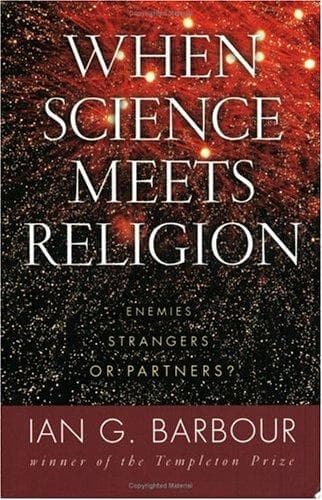
When Science Meets Religion
عندما يلتقي العلم بالدين
Quand la Science Rencontre la Religion
Editorial summary
This seminal work examines the complex relationship between scientific and religious worldviews, proposing a typology that has become standard in science-religion discourse. Barbour identifies four primary modes of interaction: conflict, independence, dialogue, and integration. The conflict model, exemplified by scientific materialism and biblical literalism, assumes fundamental incompatibility between scientific and religious claims. The independence approach, drawing on neo-orthodox theology and existentialist philosophy, maintains that science and religion operate in separate domains with distinct languages and methods. The dialogue position seeks conversation between disciplines while respecting their integrity, exploring methodological parallels and boundary questions. Integration, Barbour's preferred stance, pursues more systematic synthesis through natural theology, theology of nature, or process thought.
The monograph provides detailed case studies across physics, evolutionary biology, and neuroscience, demonstrating how each interaction model handles specific issues. In cosmology, Barbour examines how different approaches interpret Big Bang theory and anthropic fine-tuning. His treatment of evolution considers various theological responses to Darwinism, from creationist rejection to theistic evolution. The consciousness debate receives particular attention, as Barbour explores dualist, materialist, and emergentist positions on mind-body relations.
Barbour's methodology combines historical analysis with philosophical argument, drawing extensively on twentieth-century theology and philosophy of science. His intellectual framework reflects the influence of process philosophy, particularly Whitehead, though he engages seriously with alternative positions. The work responds to both reductionist scientists like Richard Dawkins and fundamentalist religious voices, arguing that both represent the conflict model's limitations.
The monograph's significance lies in providing conceptual clarity to a confused cultural conversation. By mapping distinct approaches to science-religion interaction, Barbour enables more precise analysis of specific disputes. His typology reveals that apparent conflicts often stem from category confusion rather than substantive disagreement. The work influences subsequent scholars like John Polkinghorne and Alister McGrath, who refine and critique Barbour's categories.
Critics challenge Barbour's apparent bias toward integration, suggesting his typology implicitly privileges this approach. Some argue his categories oversimplify complex historical positions that combine elements from multiple models. Nevertheless, the work remains foundational for academic science-religion dialogue, offering essential vocabulary for analyzing how scientific and theological claims relate. Barbour demonstrates that the science-religion relationship admits multiple legitimate interpretations, each with distinct philosophical commitments and practical implications.
Argument formulations engaged
Related works
Barbour, Ian (2000). When Science Meets Religion. HarperOne.
@book{when-science-meets-religion-2000,
  author    = {Barbour, Ian},
  title     = {When Science Meets Religion},
  year      = {2000},
  publisher = {HarperOne},
  url       = {https://god-database.com/en/works/when-science-meets-religion-2000}
}