
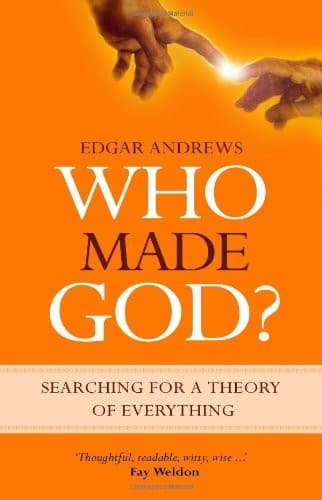
Who Made God?
من صنع الله؟
Qui a Créé Dieu ?
Editorial summary
This monograph addresses one of the most persistent objections to theistic arguments: if God created everything, then who created God? Edgar Andrews, a physicist and materials scientist, approaches this ancient philosophical question through the lens of modern scientific understanding, particularly drawing on concepts from physics and cosmology to defend classical theism against contemporary atheistic challenges.
Andrews structures his argument around the fundamental distinction between contingent and necessary existence, arguing that the question "Who made God?" rests on a category error. He contends that while everything within the physical universe requires a cause or explanation for its existence, God by definition exists necessarily and eternally, requiring no external cause. The author employs analogies from physics, particularly the concept of dimensions and the nature of time, to illustrate how a being existing outside the space-time continuum would not be subject to the causal chains that govern temporal entities.
The work engages directly with the New Atheist movement, particularly responding to arguments advanced by Richard Dawkins in The God Delusion. Andrews critiques Dawkins' assertion that postulating God merely pushes the problem of complexity back a step, arguing instead that divine simplicity and necessity provide a coherent stopping point for explanation that materialism cannot offer. He examines the logical structure of infinite regress arguments and demonstrates why they support rather than undermine the case for a necessary being.
Andrews dedicates substantial attention to the relationship between scientific laws and divine action, arguing that the regularity and mathematical elegibility of natural laws point toward a rational creator rather than away from one. He addresses multiverse theories and anthropic principle discussions, maintaining that these explanations for cosmic fine-tuning ultimately fail to eliminate the need for a transcendent cause. The author also explores the limits of scientific methodology when addressing metaphysical questions, arguing that science's inability to answer "why" questions about ultimate origins points to the need for philosophical and theological frameworks.
The monograph's significance lies in its attempt to bridge scientific and theological discourse, offering scientifically literate believers intellectual resources for defending theistic belief while challenging the philosophical assumptions underlying scientific materialism. Andrews demonstrates how classical theistic concepts remain philosophically robust when properly understood, even in light of modern scientific knowledge.
Argument formulations engaged
Related works
Andrews, Edgar (2009). Who Made God?. Evangelical Press.
@book{who-made-god-2009,
  author    = {Andrews, Edgar},
  title     = {Who Made God?},
  year      = {2009},
  publisher = {Evangelical Press},
  url       = {https://god-database.com/en/works/who-made-god-2009}
}