
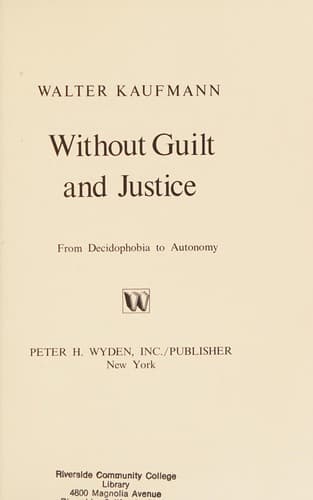
Without Guilt and Justice: From Decidophobia to Autonomy
بلا ذنب وبلا عدالة: من رهاب القرار إلى الاستقلالية
Sans culpabilité ni justice : De la décidophobie à l'autonomie
Editorial summary
Walter Kaufmann's Without Guilt and Justice: From Decidophobia to Autonomy presents a radical critique of traditional moral frameworks, arguing that concepts of guilt, justice, and desert fundamentally obstruct human autonomy and authentic self-creation. Writing in the wake of existentialism's influence on American philosophy, Kaufmann develops a systematic attack on what he terms "decidophobia" - the fear of making fateful decisions without divine or metaphysical guarantees.
The work directly challenges theistic ethics by arguing that belief in cosmic justice and divine judgment perpetuates psychological dependence and moral immaturity. Kaufmann contends that the notion of desert - that people deserve reward or punishment based on their actions - represents a primitive retributive mindset incompatible with genuine human freedom. He traces this concept through religious traditions, particularly Christianity, demonstrating how belief in ultimate justice serves as a crutch preventing individuals from accepting full responsibility for their choices and values.
Kaufmann's method combines philosophical analysis with psychological insight, drawing extensively from Nietzsche while avoiding his rhetorical excesses. He systematically dismantles arguments for objective morality, whether grounded in divine command, natural law, or rational principles. The work engages critically with both religious thinkers who defend transcendent moral order and secular philosophers who attempt to preserve notions of desert and justice without theological foundations. Kaufmann argues that even secular versions of justice retain the psychological structure of religious thinking, substituting abstract principles for divine will.
The monograph's constructive proposal centers on autonomy as the highest human achievement - not merely freedom from external constraints, but the courage to create values without seeking validation from God, nature, or universal reason. Kaufmann advocates for what he calls "the tragic view," accepting that life contains irreconcilable conflicts and undeserved suffering without retreating into comforting myths of cosmic justice.
This work significantly advances the God debate by demonstrating how rejection of theistic morality need not lead to nihilism but can ground a robust ethics of self-creation. Kaufmann's analysis reveals the deep psychological connections between belief in God and belief in justice, suggesting that authentic atheism requires abandoning both. His argument that decidophobia underlies much religious belief provides a powerful psychological explanation for the persistence of theism in modern society.
Argument formulations engaged
Related works
Kaufmann, Walter (1973). Without Guilt and Justice: From Decidophobia to Autonomy. Peter H. Wyden.
@book{without-guilt-and-justice-from-decidopho,
  author    = {Kaufmann, Walter},
  title     = {Without Guilt and Justice: From Decidophobia to Autonomy},
  year      = {1973},
  publisher = {Peter H. Wyden},
  url       = {https://god-database.com/en/works/without-guilt-and-justice-from-decidophobia-to-autonomy-1973}
}