
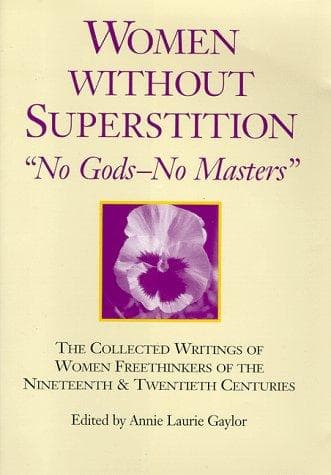
Women Without Superstition: No Gods, No Masters
نساء بلا خرافات: لا آلهة، لا سادة
Femmes sans superstition : Ni dieux, ni maîtres
Editorial summary
This groundbreaking anthology assembles writings by pioneering women freethinkers spanning three centuries, demonstrating how female intellectuals have consistently challenged religious orthodoxy alongside patriarchal structures. Gaylor's editorial project recovers a marginalized tradition within both feminist history and the broader freethought movement, revealing how women's critiques of religion have been systematically overlooked in standard accounts of secularization and atheist philosophy.
The volume features over fifty contributors, from Mary Wollstonecraft and Harriet Martineau to Elizabeth Cady Stanton and Emma Goldman, presenting their arguments against religious belief through letters, essays, speeches, and autobiographical reflections. Gaylor's editorial framework emphasizes the intersection of religious skepticism with women's rights advocacy, showing how these thinkers recognized organized religion as a primary instrument of female subjugation. The collection demonstrates that rejecting divine authority often coincided with rejecting male authority, making atheism and feminism mutually reinforcing intellectual positions.
The editor's substantial biographical introductions contextualize each writer within her historical moment while tracing connections across generations. This editorial apparatus reveals how women freethinkers faced double marginalization - dismissed by religious establishments for their skepticism and excluded from male-dominated freethought organizations. The anthology documents how figures like Ernestine Rose and Frances Wright articulated sophisticated philosophical arguments against theism while simultaneously advocating for suffrage, birth control, and economic independence.
Methodologically, the volume combines intellectual history with feminist recovery work, employing archival research to resurrect texts that have been out of print for decades or centuries. Gaylor's selection criteria privilege writings that explicitly address religious questions rather than merely implicit critiques, ensuring the anthology's focus remains on substantive engagement with theological claims. The chronological arrangement traces evolving arguments from Enlightenment rationalism through nineteenth-century scientific materialism to twentieth-century existential and political critiques.
The work's significance extends beyond historical documentation, offering contemporary relevance to debates about religion's role in perpetuating gender inequality. By establishing a genealogy of female atheist thought, Gaylor challenges both the masculine coding of rational skepticism and the assumption that women are naturally more religious. The anthology provides crucial evidence that women have been active participants in the intellectual dismantling of religious belief systems, contributing distinctive analyses that link theological critique to broader emancipatory projects.
Argument formulations engaged
Gaylor, Annie Laurie (1997). Women Without Superstition: No Gods, No Masters.
@book{women-without-superstition-no-gods-no-ma,
  author    = {Gaylor, Annie Laurie},
  title     = {Women Without Superstition: No Gods, No Masters},
  year      = {1997},
  url       = {https://god-database.com/en/works/women-without-superstition-no-gods-no-masters-1997}
}