
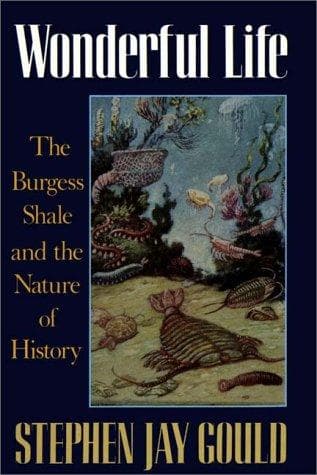
Wonderful Life: The Burgess Shale and the Nature of History
الحياة الرائعة: صخر بورجيس وطبيعة التاريخ
La vie est belle : Les schistes de Burgess et la nature de l'histoire
Editorial summary
Stephen Jay Gould's Wonderful Life examines the Cambrian explosion through the lens of the Burgess Shale fossils to advance a radical thesis about evolutionary history's contingency. While ostensibly a work of paleontology, the book carries profound implications for traditional arguments from design and challenges both theistic and atheistic interpretations of life's development.
Gould's central argument rests on what he terms the "contingency of history." Through meticulous analysis of the Burgess Shale's bizarre Cambrian fauna, he demonstrates that evolutionary outcomes depend on countless unpredictable factors rather than inevitable progress. His famous thought experiment of "replaying life's tape" suggests that if evolution began anew, entirely different forms would emerge. This directly confronts both the theistic notion of divinely guided evolution and the secular faith in progress toward increasing complexity and intelligence.
The work systematically dismantles what Gould identifies as the "cone of increasing diversity" model, which depicts evolution as necessarily producing greater variety and complexity over time. Instead, he proposes that the Cambrian explosion produced more fundamental body plans than exist today, with subsequent history marked by decimation rather than expansion. This reversal undermines natural theology arguments that see divine purpose in life's apparent directionality.
Gould's methodology combines technical paleontological analysis with philosophical reflection on scientific interpretation. He traces how earlier researchers like Charles Walcott imposed progressive narratives onto the Burgess fossils, revealing how metaphysical assumptions shape scientific conclusions. This reflexive approach exposes the cultural embeddedness of both religious and secular readings of natural history.
The book's significance for the God debate lies in its challenge to anthropocentric interpretations of evolution. By demonstrating humanity's emergence as a wildly improbable accident rather than an inevitable outcome, Gould undermines both traditional design arguments and their secular counterparts that locate meaning in evolutionary progress. His vision of a radically contingent universe resists both theistic providence and atheistic confidence in naturalistic necessity.
While Gould avoids explicit theological discussion, his framework suggests a universe neither designed nor meaningfully directed. The work thus provides sophisticated ammunition for non-theistic worldviews while avoiding simplistic materialism. Its lasting contribution lies in complicating narratives that seek transcendent meaning or direction in evolutionary history, whether sourced in divine intention or natural law.
Argument formulations engaged
Gould, Stephen Jay (1989). Wonderful Life: The Burgess Shale and the Nature of History.
@book{wonderful-life-the-burgess-shale-and-the,
  author    = {Gould, Stephen Jay},
  title     = {Wonderful Life: The Burgess Shale and the Nature of History},
  year      = {1989},
  url       = {https://god-database.com/en/works/wonderful-life-the-burgess-shale-and-the-nature-of-history-1989}
}