
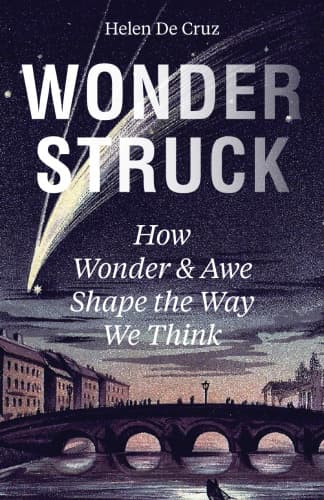
Wonderstruck: How Wonder and Awe Shape the Way We Think
مندهش: كيف تشكل الدهشة والإعجاب طريقة تفكيرنا
Émerveillé : Comment l'émerveillement et la crainte façonnent notre façon de penser
Editorial summary
This monograph examines how experiences of wonder and awe function as cognitive and epistemic tools that shape human reasoning, particularly in domains concerning ultimate questions about reality, meaning, and the divine. Helen De Cruz argues that wonder is not merely an emotional response but a fundamental driver of intellectual inquiry that bridges scientific, philosophical, and religious thinking.
De Cruz develops a naturalistic account of wonder that draws on cognitive science, evolutionary psychology, and phenomenology to explain how awe-inducing experiences generate unique epistemic states. She contends that wonder creates cognitive openings that allow humans to transcend ordinary conceptual frameworks and consider possibilities beyond immediate empirical constraints. This capacity, she argues, explains why wonder features prominently in both scientific discovery and religious experience.
The work engages critically with reductionist accounts that dismiss wonder-based reasoning as primitive or unreliable. Against strict naturalists who view awe as an evolutionary byproduct with no epistemic value, De Cruz demonstrates that wonder-driven inquiry has produced significant advances in mathematics, science, and philosophy. She examines historical cases where experiences of wonder led to paradigm shifts, suggesting that this cognitive mode complements rather than opposes analytical reasoning.
Regarding religious belief, De Cruz adopts a nuanced position. She argues that while wonder experiences often generate or reinforce theistic beliefs, they do not constitute evidence for God's existence in any straightforward sense. Instead, she presents wonder as creating epistemic possibilities that make certain metaphysical frameworks more cognitively attractive or plausible. This approach sidesteps traditional natural theology while acknowledging the rational intelligibility of wonder-based religious beliefs.
The monograph makes an important contribution to debates about the rationality of religious belief by reframing the discussion around cognitive mechanisms rather than propositional arguments. De Cruz challenges both religious apologists who overstate wonder's evidential value and skeptics who dismiss it entirely. Her interdisciplinary methodology, combining empirical research with philosophical analysis, offers a fresh perspective on perennial questions about the relationship between human cognitive architecture and metaphysical beliefs.
The work's significance lies in its sophisticated treatment of wonder as neither proof nor delusion, but as a distinctive mode of human cognition that shapes how people approach ultimate questions. This framework provides new resources for understanding why the God question remains persistently compelling across cultures while avoiding simplistic explanations from either religious or irreligious perspectives.
Argument formulations engaged
Related works
De Cruz, Helen (2024). Wonderstruck: How Wonder and Awe Shape the Way We Think. Princeton University Press.
@book{wonderstruck-how-wonder-and-awe-shape-th,
  author    = {De Cruz, Helen},
  title     = {Wonderstruck: How Wonder and Awe Shape the Way We Think},
  year      = {2024},
  publisher = {Princeton University Press},
  url       = {https://god-database.com/en/works/wonderstruck-how-wonder-and-awe-shape-the-way-we-think-2024}
}