
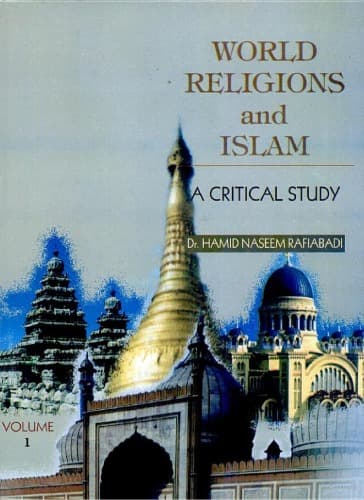
World Religions and Islam.. A Critical Study
أديان العالم والإسلام.. دراسة نقدية
Les religions du monde et l'islam.. Une étude critique
A comparative examination of world religions from an Islamic perspective argues that Islam offers a more coherent and complete framework for understanding God, revelation, and human purpose than other religious traditions.
Editorial summary
This monograph examines the relationship between Islam and other world religions through a critical comparative lens, presenting Islamic perspectives on religious diversity while engaging with questions about divine revelation and prophethood across traditions. Rafiabadi structures his analysis around the Islamic theological framework that acknowledges previous revelations while asserting Islam's role as the final and complete manifestation of divine guidance.
The work employs a comparative religious methodology that juxtaposes Islamic teachings with those of Christianity, Judaism, Hinduism, Buddhism, and other major traditions. Rafiabadi examines theological concepts, scriptural narratives, ritual practices, and ethical systems across these religions, identifying both convergences and divergences from an Islamic standpoint. His approach combines textual analysis of the Quran and hadith literature with engagement with scholarly works from various religious traditions, though primarily filtered through an Islamic interpretive framework.
Central to Rafiabadi's argument is the Islamic doctrine of prophetic continuity, which holds that God has sent messengers to all peoples throughout history, with Muhammad representing the seal of prophethood. This theological position allows him to acknowledge truths within other religions while maintaining Islam's claim to supersession and completion of earlier revelations. He critically examines how other religions understand prophecy, revelation, and divine communication, contrasting these with Islamic conceptions of wahy (revelation) and nubuwwah (prophethood).
The author addresses contemporary challenges in interfaith dialogue, including religious pluralism, exclusivism, and the possibility of salvation outside Islam. While maintaining traditional Islamic theological boundaries, Rafiabadi engages with modernist Muslim thinkers who have advocated for more inclusive approaches to religious diversity. He critiques both rigid exclusivism and uncritical pluralism, seeking a middle path that preserves Islamic theological integrity while fostering respectful engagement with other faiths.
The work's significance lies in its attempt to provide English-speaking audiences with an Islamic perspective on comparative religion that goes beyond apologetics. Rafiabadi demonstrates how Islamic theology can engage seriously with religious diversity while maintaining its own truth claims. His treatment of the prophecy argument shows how this classical Islamic doctrine functions not merely as a claim to superiority but as a framework for understanding religious history and diversity. The monograph contributes to contemporary discussions about religious pluralism by presenting a perspective that is both grounded in traditional Islamic sources and responsive to modern interfaith challenges.
Structured analysis
Argument formulations engaged
Rafiabadi, Hamid Naseem (2003). World Religions and Islam.. A Critical Study.
@book{world-religions-and-islam-a-critical-stu,
  author    = {Rafiabadi, Hamid Naseem},
  title     = {World Religions and Islam.. A Critical Study},
  year      = {2003},
  url       = {https://god-database.com/en/works/world-religions-and-islam-a-critical-study}
}