
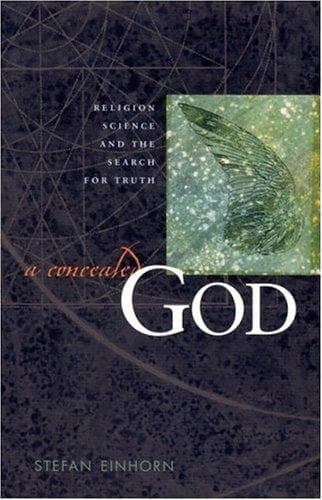
A Concealed God.. Religion, Science and the Search of Truth
إله مخفي.. الدين والعلم والبحث عن الحقيقة
Un Dieu caché.. Religion, science et la quête de la vérité
God, though concealed from direct empirical verification, remains a serious and rationally defensible hypothesis when science and religion are brought into genuine dialogue rather than opposition.
Editorial summary
Stefan Einhorn's monograph explores the complex relationship between religious belief and scientific inquiry, examining how both domains approach fundamental questions about reality and truth. Writing from a Swedish cultural context where secularization has significantly shaped intellectual discourse, Einhorn investigates whether scientific advancement necessarily diminishes religious conviction or whether these two modes of understanding can coexist meaningfully.
The work employs a descriptive-analytical methodology to survey various positions on the compatibility of science and religion. Einhorn examines historical cases where scientific discoveries challenged religious worldviews, as well as instances where religious thinkers have embraced scientific findings as complementary to faith. He analyzes how different religious traditions have responded to scientific materialism, from defensive rejection to sophisticated integration. The author particularly focuses on how modern physics, evolutionary biology, and neuroscience have influenced contemporary theological reflection.
Central to Einhorn's analysis is the metaphor of divine hiddenness - the notion that if God exists, divine presence remains concealed rather than empirically obvious. He explores how this concept functions differently across religious traditions and examines whether divine hiddenness represents a theological problem or an essential feature of authentic faith. The work engages with philosophers who have developed arguments from divine hiddenness against theism, while also considering theological responses that frame hiddenness as necessary for human moral development or genuine relationship with the divine.
Einhorn's contribution lies in his balanced presentation of cumulative case arguments from multiple perspectives. Rather than advocating for a particular position, he demonstrates how both religious believers and skeptics marshal evidence from science, philosophy, and human experience to support their worldviews. He examines how personal, cultural, and psychological factors influence the interpretation of evidence regarding ultimate questions. The work illuminates why equally rational individuals can reach divergent conclusions about God's existence when confronting the same scientific and philosophical data.
The monograph serves as a valuable resource for understanding the contemporary science-religion dialogue, particularly in secular European contexts. Einhorn's careful analysis reveals how the search for truth operates differently within scientific and religious frameworks, while suggesting that both approaches address complementary aspects of human existence and meaning. His work challenges simplistic narratives about inevitable conflict between science and religion, presenting instead a nuanced picture of ongoing dialogue and mutual influence.
Structured analysis
Structure of the work
Argument formulations engaged
Einhorn, Stefan (1998). A Concealed God.. Religion, Science and the Search of Truth. Templeton Foundation Press.
@book{a-concealed-god-religion-science-and-the,
  author    = {Einhorn, Stefan},
  title     = {A Concealed God.. Religion, Science and the Search of Truth},
  year      = {1998},
  publisher = {Templeton Foundation Press},
  url       = {https://god-database.com/en/works/a-concealed-god-religion-science-and-the-search-of-truth}
}