
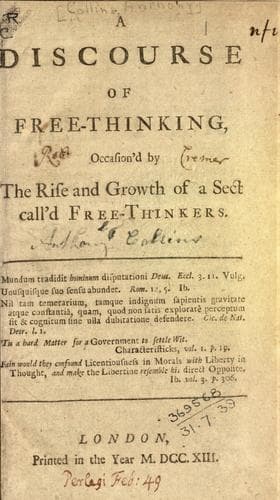
A Discourse of Free-Thinking
خطاب في حرية التفكير
Un discours sur la libre-pensée
Editorial summary
Anthony Collins's A Discourse of Free-Thinking stands as a pivotal early Enlightenment text that champions reason as the primary instrument for evaluating religious claims. Written in 1713, the work emerges from the heated debates between orthodox Anglican theologians and the emerging deist movement in England. Collins argues that free-thinking, defined as the unfettered exercise of reason in matters of religion, constitutes not merely a right but a moral duty for all individuals seeking truth about God and religious doctrine.
The discourse systematically dismantles the authority of clerical interpretation and religious tradition. Collins contends that priests and theologians have deliberately obscured religious truths through contradictory interpretations and appeals to mystery, making independent rational inquiry essential. He marshals extensive evidence of disagreements among clergy across denominations to demonstrate that religious authority cannot provide reliable knowledge about divine matters. This argument directly challenges contemporary Anglican divines like Samuel Clarke and Benjamin Hoadly, who sought to reconcile reason with revelation while maintaining ecclesiastical authority.
Collins's method combines historical criticism with philosophical analysis. He examines biblical texts, patristic writings, and contemporary theological disputes to show how religious doctrines have varied across time and culture. This historicist approach undermines claims to unchanging religious truth and suggests that beliefs about God reflect human construction rather than divine revelation. The work particularly targets the doctrine of the Trinity and prophecies concerning Christ, arguing these fail rational scrutiny when examined without presuppositions.
The broader significance of Collins's discourse lies in its radical democratization of religious inquiry. By insisting that ordinary individuals possess sufficient rational capacity to evaluate religious claims, Collins challenges the entire structure of religious authority in early modern society. His work influenced subsequent deist writers and contributed to the growing skepticism toward revealed religion that characterized the Enlightenment. While Collins maintains a nominal theism, acknowledging a creator God discoverable through reason, his relentless critique of Christian orthodoxy and revelation effectively undermines traditional theistic belief systems.
The discourse represents a crucial moment in the secularization of European thought, shifting the locus of religious authority from institutional tradition to individual reason. Collins's arguments prefigure later Enlightenment critiques of religion while establishing free-thinking as both an intellectual method and a political principle that would profoundly shape modern approaches to the question of God.
Argument formulations engaged
Related works
Collins, Anthony (1713). A Discourse of Free-Thinking.
@book{a-discourse-of-free-thinking-1713,
  author    = {Collins, Anthony},
  title     = {A Discourse of Free-Thinking},
  year      = {1713},
  url       = {https://god-database.com/en/works/a-discourse-of-free-thinking-1713}
}