
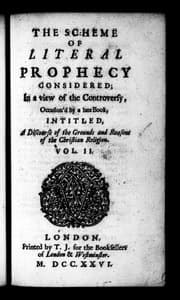
The Scheme of Literal Prophecy Considered
مخطط النبوءة الحرفية قيد النظر
Le Schéma de la prophétie littérale considéré
Editorial summary
Anthony Collins's "The Scheme of Literal Prophecy Considered" (1726) constitutes a pivotal intervention in early Enlightenment debates concerning biblical authority and the rational foundations of Christianity. The work systematically challenges traditional Christian apologetics by subjecting prophetic claims to rigorous textual and historical scrutiny, particularly examining the purported fulfillment of Old Testament prophecies in the New Testament.
Collins directs his critique against contemporary defenders of Christianity who argue that fulfilled prophecy provides demonstrable proof of divine revelation. His method employs close philological analysis combined with historical contextualization, examining specific prophetic passages that Christian apologists claim refer to Christ. Through meticulous comparison of Hebrew texts with their New Testament applications, Collins argues that these prophecies, when read in their original contexts, refer to immediate historical circumstances rather than distant messianic events.
The work's central contention holds that Christian interpretations of prophecy rely on allegorical and typological readings that depart from literal meaning. Collins demonstrates how prophecies cited by New Testament authors often require significant interpretative manipulation to apply to Jesus, involving selective quotation, mistranslation, or removal from context. This analysis extends to examining Jewish interpretative traditions, which Collins uses to show that messianic readings of these texts represent later Christian innovations rather than original meanings.
Collins situates his argument within broader Enlightenment concerns about reason and revelation. His work responds to William Whiston and other rational theologians who sought to defend Christianity through historical and textual evidence. By undermining prophecy as proof of Christianity's divine origin, Collins contributes to the period's growing skepticism toward miraculous claims and supernatural explanations. His approach reflects the era's confidence in human reason and empirical investigation as tools for evaluating religious claims.
The significance of Collins's treatise extends beyond its immediate polemical context. It advances critical biblical scholarship by insisting on historical-grammatical interpretation over theological eisegesis. The work influences subsequent debates about biblical interpretation, religious authority, and the relationship between faith and reason. Collins's methodology anticipates later historical-critical approaches to scripture, while his conclusions fuel deist critiques of revealed religion. His systematic dismantling of prophetic proof represents a crucial moment in the Enlightenment's challenge to traditional religious epistemology, contributing to broader questions about how religious truth claims can be evaluated through rational inquiry.
Argument formulations engaged
Related works
Collins, Anthony (1726). The Scheme of Literal Prophecy Considered.
@book{the-scheme-of-literal-prophecy-considere,
  author    = {Collins, Anthony},
  title     = {The Scheme of Literal Prophecy Considered},
  year      = {1726},
  url       = {https://god-database.com/en/works/the-scheme-of-literal-prophecy-considered-1726}
}