
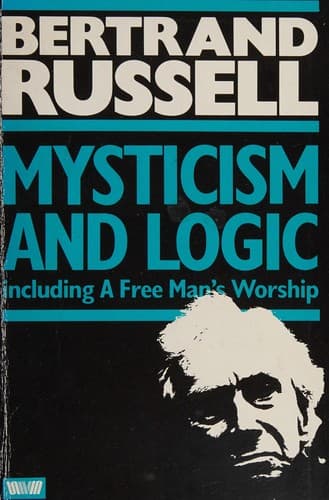
A Free Man's Worship
عبادة الرجل الحر
Le Culte d'un Homme Libre
Editorial summary
Bertrand Russell's "A Free Man's Worship" stands as a foundational text in early twentieth-century atheistic philosophy, articulating a vision of human dignity and meaning within a godless universe. Written against the backdrop of Victorian religious certainty's erosion and emerging scientific materialism, the essay confronts the existential implications of accepting that humanity exists without divine purpose or cosmic significance. Russell develops his argument through a synthesis of scientific naturalism and romantic humanism, creating what becomes a template for secular responses to nihilism.
The essay opens with Russell's stark portrayal of the universe as revealed by science: a realm of blind forces and genetic accidents, devoid of intention or benevolence. He presents humanity as an accidental byproduct of mechanical processes, destined for extinction alongside Earth itself. This cosmic pessimism serves as Russell's starting point rather than his conclusion. Against this backdrop of ultimate meaninglessness, he constructs an argument for human value grounded not in external validation but in humanity's unique capacity for thought, beauty, and moral aspiration.
Russell's method combines lyrical prose with philosophical argumentation, employing mythological imagery to convey abstract concepts. His famous retelling of the Prometheus myth functions as an allegory for humanity's relationship to an indifferent cosmos. Where traditional theodicy attempts to justify suffering within divine providence, Russell inverts this approach, arguing that humanity's greatness emerges precisely from its cosmic abandonment. The essay's rhetorical power derives from this paradoxical move: transforming apparent grounds for despair into sources of nobility.
The work's significance extends beyond its immediate atheistic argument. Russell establishes key themes that dominate subsequent secular philosophy: the burden of creating meaning without transcendent authority, the role of art and knowledge as consolations for mortality, and the possibility of ethics without divine command. His emphasis on human solidarity in the face of cosmic indifference anticipates later existentialist thought while maintaining a distinctly British empiricist framework.
"A Free Man's Worship" matters to the God debate because it demonstrates how rejection of theism need not lead to nihilistic despair. Russell provides a model for constructing meaning and maintaining moral commitment within a naturalistic worldview. His essay remains influential for those seeking to articulate how human life can possess dignity and purpose without recourse to religious frameworks, establishing emotional and aesthetic dimensions of atheism often overlooked in purely analytical treatments.
Argument formulations engaged
Russell, Bertrand (1903). A Free Man's Worship.
@book{a-free-mans-worship-1903,
  author    = {Russell, Bertrand},
  title     = {A Free Man's Worship},
  year      = {1903},
  url       = {https://god-database.com/en/works/a-free-mans-worship-1903}
}