
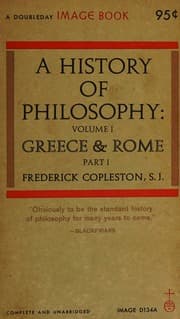
A History of Philosophy
تاريخ الفلسفة
Une histoire de la philosophie
Editorial summary
Copleston's monumental nine-volume A History of Philosophy stands as one of the twentieth century's most comprehensive philosophical surveys, offering a distinctively Catholic perspective on Western thought from ancient Greece to contemporary philosophy. While not primarily focused on arguments for or against God's existence, the work significantly contributes to understanding how the God question has evolved throughout philosophical history, making it an invaluable resource for scholars examining theistic and atheistic traditions.
Written between 1946 and 1975, Copleston's project emerges from the Neo-Thomist revival, reflecting his Jesuit training while maintaining scholarly objectivity. His treatment of medieval philosophy proves particularly influential, rehabilitating scholastic thinkers often dismissed by secular historians. Copleston demonstrates how figures like Aquinas and Scotus developed sophisticated philosophical systems that remain relevant to contemporary debates about God's existence, divine attributes, and the relationship between faith and reason.
The work's contribution to the God debate operates on multiple levels. First, Copleston traces how arguments about divinity shift from ancient cosmological concerns through medieval synthesis to modern skepticism and postmodern critique. He carefully explicates each philosopher's position on God, whether defending Anselm's ontological argument, analyzing Kant's demolition of traditional proofs, or examining Nietzsche's declaration of divine death. Second, his methodology reveals how philosophical arguments about God cannot be divorced from broader metaphysical, epistemological, and ethical frameworks.
Copleston's balanced exposition allows readers to understand why certain arguments for God's existence gained prominence in specific historical contexts and why others fell from favor. His treatment of modern philosophy particularly illuminates how the God question transforms from medieval certainty through Enlightenment critique to existentialist ambiguity. While critics note his somewhat unsympathetic treatment of materialism and his privileging of theistic philosophy, even secular scholars acknowledge his fair presentation of opposing viewpoints.
The History's enduring value lies in demonstrating that the God debate represents not a single question but an evolving dialogue shaped by changing intellectual paradigms. Copleston shows how each era's approach to divinity reflects broader cultural and philosophical commitments, making his work essential for anyone seeking to understand how Western philosophy has grappled with ultimate questions. His synthesis remains unmatched in scope and remains standard reading for understanding philosophy's engagement with theistic thought.
Argument formulations engaged
Related works
Copleston, Frederick (1946). A History of Philosophy.
@book{a-history-of-philosophy-1946,
  author    = {Copleston, Frederick},
  title     = {A History of Philosophy},
  year      = {1946},
  url       = {https://god-database.com/en/works/a-history-of-philosophy-1946}
}