
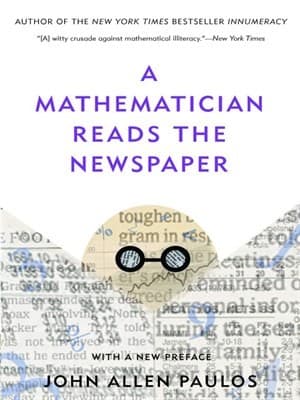
A Mathematician Reads the Newspaper
رياضي يقرأ الصحيفة
Un mathématicien lit le journal
Editorial summary
This work examines how mathematical illiteracy shapes public discourse and belief formation, with implications for how contemporary societies evaluate religious and metaphysical claims. Paulos analyzes newspaper coverage across multiple domains—from politics and economics to science and pseudoscience—demonstrating how innumeracy enables the persistence of unfounded beliefs, including supernatural and religious explanations for natural phenomena.
The author employs statistical analysis and probability theory to dissect common fallacies in public reasoning. He shows how misunderstandings of coincidence, correlation, and causation create cognitive environments where miraculous interpretations flourish unnecessarily. When examining reports of answered prayers or divine intervention, Paulos demonstrates how selection bias and the law of large numbers provide more parsimonious explanations than supernatural agency. His analysis of psychic predictions and astrological claims extends this critique to quasi-religious belief systems that similarly exploit mathematical ignorance.
Paulos situates his argument within the broader framework of scientific skepticism, drawing on the rationalist tradition that views mathematical literacy as essential for distinguishing legitimate from illegitimate knowledge claims. His work engages implicitly with debates about the compatibility of religious belief and scientific reasoning, suggesting that improved numeracy naturally erodes the plausibility of supernatural explanations. The text addresses how media representations of uncertainty—particularly in science reporting—create false equivalences between evidence-based and faith-based worldviews.
The monograph's significance for discussions about God lies in its systematic demonstration of how probabilistic reasoning undermines arguments from design, personal revelation, and miraculous intervention. Without directly attacking theism, Paulos shows how mathematical thinking provides naturalistic explanations for phenomena often attributed to divine action. His analysis of risk perception and rare events particularly challenges providentialist interpretations of fortune and misfortune.
While not primarily a work of philosophy of religion, the text contributes to naturalistic critiques of religious belief by identifying specific cognitive mechanisms that sustain supernatural thinking in modern societies. Paulos reveals how innumeracy functions as a protective barrier for religious claims, shielding them from statistical scrutiny that would otherwise expose their improbability. His work suggests that mathematical education serves not merely technical purposes but shapes fundamental orientations toward evidence, causation, and the boundaries between natural and supernatural explanation.
Paulos, John Allen (1995). A Mathematician Reads the Newspaper.
@book{a-mathematician-reads-the-newspaper-1995,
  author    = {Paulos, John Allen},
  title     = {A Mathematician Reads the Newspaper},
  year      = {1995},
  url       = {https://god-database.com/en/works/a-mathematician-reads-the-newspaper-1995}
}