
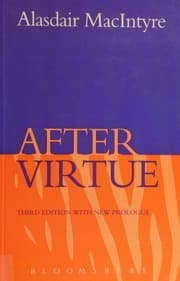
After Virtue
بعد الفضيلة
Après la vertu
Editorial summary
MacIntyre's After Virtue diagnoses a profound moral crisis in contemporary Western society, arguing that modern moral discourse has become incoherent because it employs fragments of earlier ethical traditions while rejecting the metaphysical frameworks that gave those traditions meaning. The work develops a devastating critique of the Enlightenment project of justifying morality independently of teleological conceptions of human nature, demonstrating how this project's failure has left modern societies with moral vocabularies severed from their original contexts of meaning.
Central to MacIntyre's analysis is his distinction between internal and external goods within practices, and his recovery of Aristotelian virtue ethics as an alternative to both deontological and consequentialist moral theories. He argues that virtues can only be understood within the context of practices, the narrative unity of human life, and living traditions. This framework requires a teleological understanding of human nature that modern philosophy has systematically rejected since the Enlightenment.
The work's relevance to debates about God emerges through its critique of secular morality's foundations. MacIntyre demonstrates how the rejection of Aristotelian teleology, itself bound up with medieval theological adaptations, has rendered modern moral philosophy unable to provide rational justification for its claims. While not explicitly arguing for theism, the book suggests that coherent moral discourse may require metaphysical commitments that secular modernity cannot sustain.
MacIntyre traces how emotivism has become the implicit moral philosophy of modernity, reducing moral judgments to expressions of preference. His historical narrative shows how this development followed necessarily from the Enlightenment's rejection of teleological frameworks, whether Aristotelian or theological. The work thus poses a fundamental challenge to secular ethics by suggesting that moral incoherence is not accidental but inherent to projects that divorce ethics from comprehensive accounts of human purpose.
The book's concluding vision of small communities sustaining moral traditions against the new dark ages implies that meaningful ethical life may require frameworks of meaning more substantial than liberal secularism provides. While MacIntyre focuses on Aristotelian rather than explicitly theological resources, his argument opens significant space for religious contributions to moral philosophy by demonstrating the inadequacy of purely secular foundations for ethics.
Argument formulations engaged
Related works
MacIntyre, Alasdair (1981). After Virtue. University of Notre Dame Press.
@book{after-virtue-1981,
  author    = {MacIntyre, Alasdair},
  title     = {After Virtue},
  year      = {1981},
  publisher = {University of Notre Dame Press},
  url       = {https://god-database.com/en/works/after-virtue-1981}
}