
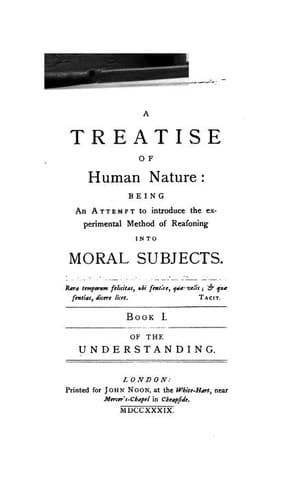
A Treatise of Human Nature
رسالة في الطبيعة الإنسانية
Traité de la Nature Humaine
Editorial summary
David Hume's "A Treatise of Human Nature" (1739) represents a watershed moment in the philosophical examination of religious belief, establishing empiricist principles that fundamentally challenge traditional arguments for God's existence. Though the work addresses human understanding broadly, its implications for natural theology prove revolutionary, subjecting religious claims to the same skeptical scrutiny Hume applies to all metaphysical propositions.
The Treatise develops a radical empiricism wherein all knowledge derives from sense impressions and their corresponding ideas. Hume argues that complex ideas, including the concept of God, must trace back to simple impressions or be dismissed as meaningless. This epistemological framework undermines a priori arguments for divine existence, as the idea of a necessary being cannot originate from experience. His analysis of causation proves particularly devastating to cosmological arguments. By reducing causation to constant conjunction and psychological habit rather than necessary connection, Hume dissolves the conceptual foundation upon which arguments from first cause depend.
The work systematically dismantles the argument from design through its treatment of analogical reasoning. Hume demonstrates that inferring an infinite, perfect creator from finite, imperfect effects violates sound reasoning principles. The Treatise suggests that even granting design in nature, one cannot legitimately conclude the existence of a single, omnipotent, benevolent deity rather than multiple, limited, or morally indifferent causes.
Regarding miracles and religious experience, though treated more extensively in later works, the Treatise's epistemology implies their profound unreliability. Since knowledge depends on the regularity of experience, testimony of miraculous events faces an insurmountable burden of proof. Religious experiences, lacking intersubjective verification, cannot ground rational belief in supernatural entities.
Writing against rationalist philosophers like Descartes and Clarke who claimed demonstrative knowledge of God, Hume's naturalistic approach reduces religion to a matter of sentiment rather than reason. His psychological account of religious belief anticipates later critiques by treating faith as a natural phenomenon subject to empirical investigation rather than a response to rational evidence.
The Treatise's significance extends beyond specific arguments to establishing a methodological naturalism that excludes supernatural explanations from philosophical inquiry. This framework influences subsequent philosophers from Kant to contemporary naturalists, making Hume's early work foundational for modern religious skepticism despite its initially lukewarm reception.
Argument formulations engaged
Related works
Hume, David (1739). A Treatise of Human Nature. John Noon.
@book{a-treatise-of-human-nature-1739,
  author    = {Hume, David},
  title     = {A Treatise of Human Nature},
  year      = {1739},
  publisher = {John Noon},
  url       = {https://god-database.com/en/works/a-treatise-of-human-nature-1739}
}