
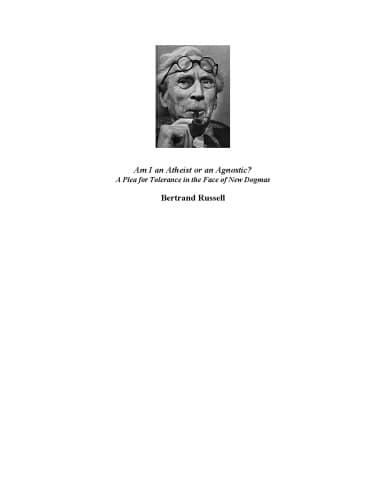
Am I an Atheist or an Agnostic?
هل أنا ملحد أم لاأدري؟
Suis-je athée ou agnostique ?
Russell argues that the labels 'atheist' and 'agnostic' are context-dependent: technically he is an agnostic (lacking proof either way), but practically he functions as an atheist, since the Christian God deserves no more credence than Zeus or Thor.
Editorial summary
Bertrand Russell's "Am I an Atheist or an Agnostic?" addresses a fundamental question of religious epistemology through careful philosophical analysis of knowledge claims and their justification. Writing within the analytic tradition, Russell examines the distinction between atheism and agnosticism, ultimately revealing the complexities inherent in categorizing one's position regarding the existence of God.
Russell employs rigorous conceptual analysis to parse the differences between claiming that God does not exist (atheism) and maintaining that one cannot know whether God exists (agnosticism). His approach reflects the analytic philosopher's commitment to precision in language and argumentation. The work engages significantly with burden of proof considerations, examining who must provide evidence in debates about divine existence. Russell argues that the burden lies with those making positive existence claims, not with those who remain unconvinced by such claims.
The monograph demonstrates Russell's characteristic attention to epistemic humility, acknowledging the limits of human knowledge while maintaining rational standards for belief formation. He distinguishes between practical and philosophical contexts, suggesting that while he might call himself an atheist in ordinary conversation, philosophically speaking, agnosticism more accurately represents his position. This nuanced stance reflects his commitment to intellectual honesty and precision.
Russell's analysis contributes to broader debates about the relationship between knowledge, belief, and certainty in religious contexts. His work challenges both dogmatic atheism and theism by emphasizing the importance of proportioning belief to evidence. The text engages with traditional philosophical questions about the nature of knowledge itself, examining what standards of evidence should apply to metaphysical claims.
The significance of Russell's contribution lies in its clarification of often-confused terminology and its demonstration that rejecting religious belief need not entail claiming certain knowledge of God's non-existence. His careful distinctions help establish a framework for more productive discussions about religious epistemology. The work exemplifies how analytic philosophy can illuminate perennial questions about God by focusing on conceptual clarity and logical rigor rather than rhetorical persuasion.
Russell's monograph remains influential in contemporary discussions about the epistemology of religious belief, providing a model for how philosophers can address questions about God with both intellectual rigor and appropriate epistemic modesty.
Structured analysis
Argument formulations engaged
Russell, Bertrand Am I an Atheist or an Agnostic?.
@book{am-i-an-atheist-or-an-agnostic,
  author    = {Russell, Bertrand},
  title     = {Am I an Atheist or an Agnostic?},
  year      = {n.d.},
  url       = {https://god-database.com/en/works/am-i-an-atheist-or-an-agnostic}
}