
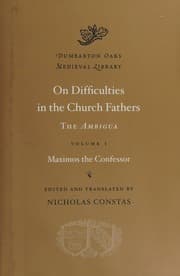
Ambigua
الغامضات
Editorial summary
Maximus the Confessor's Ambigua represents one of the most sophisticated theological works of the seventh century, addressing complex questions about divine-human relations through detailed exegesis of difficult passages in Gregory of Nazianzus and Pseudo-Dionysius. Written in 628, this extensive treatise demonstrates how patristic theology engages philosophical problems concerning God's nature, human deification, and the relationship between Creator and creation.
The work takes its name from its method of resolving "ambiguous" or difficult passages in earlier church fathers. Maximus employs this exegetical framework to develop his distinctive theological synthesis, which draws heavily on Neoplatonic philosophy while maintaining orthodox Christian commitments. His approach combines precise logical analysis with mystical insight, creating a theological method that addresses both intellectual and spiritual dimensions of the God question.
Central to the Ambigua is Maximus's doctrine of the Logos, through whom God relates to creation while remaining transcendent. He argues that all created things possess logoi (rational principles) that participate in the divine Logos, establishing both God's intimate presence in creation and absolute distinction from it. This framework allows Maximus to navigate between pantheism and an excessive emphasis on divine transcendence that would render God unknowable.
The text engages critically with Origenist cosmology, particularly rejecting the pre-existence of souls and the notion that material creation resulted from a primordial fall. Instead, Maximus develops a positive theology of creation that sees the material world as inherently good and intended for deification. His arguments provide sophisticated responses to Platonic dualism while incorporating Neoplatonic insights about participation and hierarchy.
Maximus's treatment of human nature and destiny proves especially significant for theistic philosophy. He articulates how human beings can achieve theosis (deification) through cooperation with divine grace, maintaining both human freedom and divine sovereignty. This synthesis addresses perennial questions about divine action and human agency that continue to occupy philosophical theology.
The Ambigua's influence extends far beyond its immediate Byzantine context. Its philosophical rigor and mystical depth shaped both Eastern and Western theological traditions, providing resources for later medieval thought. The work demonstrates how classical theism can incorporate philosophical sophistication while maintaining experiential and practical dimensions, offering a model of theological reflection that integrates metaphysics, ethics, and spirituality in addressing fundamental questions about God and human destiny.
Argument formulations engaged
Related works
Confessor, Maximus the (628). Ambigua.
@book{ambigua-628,
  author    = {Confessor, Maximus the},
  title     = {Ambigua},
  year      = {628},
  url       = {https://god-database.com/en/works/ambigua-628}
}