
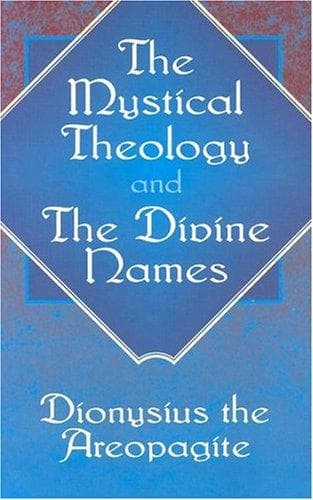
The Divine Names
الأسماء الإلهية
Les Noms divins
Editorial summary
Pseudo-Dionysius the Areopagite's The Divine Names stands as a foundational text in Christian mystical theology, offering a sophisticated framework for understanding how human language can approach discourse about God. Written around 500 CE by an anonymous author claiming to be Paul's Athenian convert, this treatise synthesizes Neoplatonic philosophy with Christian doctrine to address a fundamental theological problem: how finite human concepts can meaningfully refer to an infinite, transcendent deity.
The work's central argument revolves around the theory of divine names as both revealing and concealing God's nature. Pseudo-Dionysius contends that while God utterly transcends all categories of being and knowledge, the divine nevertheless manifests through creation in ways that permit limited human apprehension. He develops a hierarchical schema of names ascending from more material designations like "Rock" to abstract concepts such as "Goodness" and "Being," ultimately arguing that God surpasses even the most exalted attributions.
The author employs a distinctive methodological approach combining affirmative theology (kataphatic), which attributes qualities to God, with negative theology (apophatic), which strips away all determinations to acknowledge divine transcendence. This dialectical movement reaches its apex in his treatment of God as beyond both affirmation and negation, transcending the very distinction between being and non-being. His analysis of terms like "Good," "Beautiful," "Love," and "Wisdom" demonstrates how each name participates in divine reality while necessarily falling short of complete comprehension.
Pseudo-Dionysius writes against crude anthropomorphism and simplistic literalism in religious language, while equally rejecting any position that would render God-talk meaningless. His work responds to both pagan Neoplatonists who might question Christian claims about knowing God and fellow Christians who might overlook divine transcendence. The text's influence on subsequent theological thought proves immense, shaping medieval scholasticism through figures like Thomas Aquinas and mystical traditions through Meister Eckhart.
The treatise's enduring significance lies in its sophisticated navigation between religious realism and theological humility. By establishing a framework that preserves both God's transcendence and the validity of religious language, Pseudo-Dionysius provides resources for theological discourse that acknowledges its own limitations while maintaining its legitimacy. His work continues to inform contemporary discussions about religious language, mystical experience, and the relationship between philosophical and revealed theology.
Argument formulations engaged
Related works
Areopagite, Pseudo-Dionysius the (500). The Divine Names. Johns Hopkins University Press.
@book{the-divine-names-500,
  author    = {Areopagite, Pseudo-Dionysius the},
  title     = {The Divine Names},
  year      = {500},
  publisher = {Johns Hopkins University Press},
  url       = {https://god-database.com/en/works/the-divine-names-500}
}