
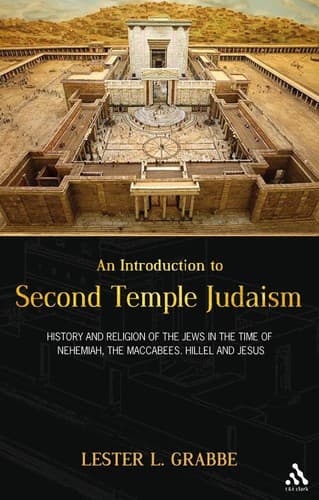
An Introduction to Second Temple Judaism: History and Religion of the Jews in the Time of Nehemiah, the Maccabees, Hillel, and Jesus
مدخل إلى يهودية الهيكل الثاني: تاريخ ودين اليهود في زمن نحميا والمكابيين وهليل ويسوع
Introduction au judaïsme du Second Temple : Histoire et religion des Juifs à l'époque de Néhémie, des Maccabées, d'Hillel et de Jésus
Editorial summary
This comprehensive survey examines the historical development and religious transformation of Judaism during the Second Temple period (539 BCE-70 CE), offering critical analysis of sources, institutions, and theological developments that shaped Jewish identity between the return from Babylonian exile and the Roman destruction of Jerusalem. Grabbe synthesizes archaeological evidence, textual sources, and contemporary scholarship to present a nuanced portrait of a formative era in Jewish history.
The work addresses fundamental questions about how Judaism evolved from its biblical foundations into the diverse religious landscape encountered in first-century Palestine. Grabbe employs a historical-critical methodology that evaluates sources for their reliability while acknowledging the limitations of available evidence. His approach challenges both maximalist readings that accept biblical narratives uncritically and minimalist positions that dismiss textual evidence entirely. The analysis demonstrates how Persian, Hellenistic, and Roman imperial contexts shaped Jewish theological reflection and practice.
Central to Grabbe's investigation is the emergence of new religious institutions and movements that redefined Jewish conceptions of divine authority, covenant, and eschatological hope. The study examines the development of the synagogue, the evolution of scriptural interpretation, and the rise of sectarian groups including Pharisees, Sadducees, Essenes, and early Christians. Particular attention focuses on how these communities negotiated questions of divine revelation, religious law, and messianic expectation within changing political circumstances.
The monograph's significance for understanding ancient conceptions of divinity lies in its documentation of theological diversity within Second Temple Judaism. Grabbe demonstrates how Jewish thinkers developed sophisticated responses to questions about divine providence, theodicy, and human agency while engaging with Hellenistic philosophical traditions. His analysis of apocalyptic literature reveals how cosmic dualism and angelology emerged as explanatory frameworks for divine action in history.
By situating early Christianity within this broader Jewish context, Grabbe provides essential background for understanding how new theological movements articulated their claims about divine revelation and messianic fulfillment. The work serves as an indispensable reference for scholars investigating the religious and intellectual environment from which both rabbinic Judaism and Christianity emerged, demonstrating how Second Temple period developments fundamentally shaped subsequent Western theological reflection.
Argument formulations engaged
Grabbe, Lester (2010). An Introduction to Second Temple Judaism: History and Religion of the Jews in the Time of Nehemiah, the Maccabees, Hillel, and Jesus. Bloomsbury UK.
@book{an-introduction-to-second-temple-judaism,
  author    = {Grabbe, Lester},
  title     = {An Introduction to Second Temple Judaism: History and Religion of the Jews in the Time of Nehemiah, the Maccabees, Hillel, and Jesus},
  year      = {2010},
  publisher = {Bloomsbury UK},
  url       = {https://god-database.com/en/works/an-introduction-to-second-temple-judaism-history-and-religion-of-the-jews-in-the-time-of-nehemiah-the-maccabees-hillel-and-jesus-2010}
}