
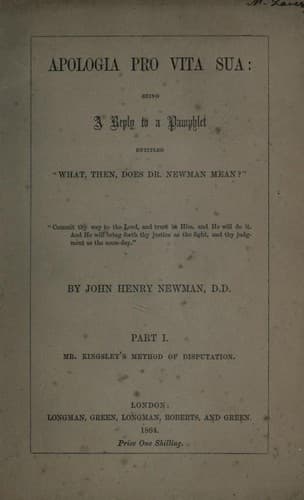
Apologia Pro Vita Sua
دفاع عن حياتي
Editorial summary
Newman's Apologia Pro Vita Sua represents a landmark contribution to Victorian religious discourse, offering both a personal intellectual autobiography and a sophisticated defense of Catholic theology against Protestant criticism. Writing in response to Charles Kingsley's accusations of clerical dishonesty, Newman transforms what begins as a personal vindication into a profound exploration of religious epistemology and the nature of faith itself.
The work traces Newman's spiritual journey from evangelical Anglicanism through the Oxford Movement to his eventual conversion to Roman Catholicism in 1845. Central to Newman's argument is his theory of doctrinal development, which posits that religious truth unfolds progressively through history rather than remaining static. This developmental approach allows Newman to reconcile apparent contradictions between primitive Christianity and contemporary Catholic practice, arguing that the latter represents the organic growth of the former rather than corruption or innovation.
Newman's methodology combines rigorous historical analysis with phenomenological attention to the lived experience of faith. He argues that religious belief operates through what he terms the "illative sense" - a faculty that integrates reason, conscience, and intuition to reach certitude in matters where demonstrative proof remains impossible. This epistemological framework challenges both rationalist demands for mathematical certainty in religious matters and fideistic rejections of reason's role in faith.
The Apologia engages critically with the Protestant principle of sola scriptura, contending that Scripture alone cannot serve as the sole authority for Christian doctrine without an interpretive tradition and teaching authority. Newman demonstrates how his Anglican colleagues' appeals to antiquity ultimately led him to recognize papal authority as the necessary guarantor of doctrinal continuity.
The work's significance extends beyond denominational polemics to address fundamental questions about religious authority, the relationship between faith and reason, and the psychology of belief. Newman's nuanced treatment of conscience as the aboriginal voice of God within human consciousness provides a sophisticated response to emerging secular critiques of religion while maintaining orthodox Christian commitments.
His influence on subsequent Catholic theology, particularly regarding the development of doctrine and the role of the laity, proved substantial. The Apologia remains essential reading for understanding Victorian religious thought and continues to inform contemporary debates about religious epistemology, conversion, and the nature of theological truth claims.
Argument formulations engaged
Related works
Newman, John Henry (1865). Apologia Pro Vita Sua.
@book{apologia-pro-vita-sua-1865,
  author    = {Newman, John Henry},
  title     = {Apologia Pro Vita Sua},
  year      = {1865},
  url       = {https://god-database.com/en/works/apologia-pro-vita-sua-1865}
}