
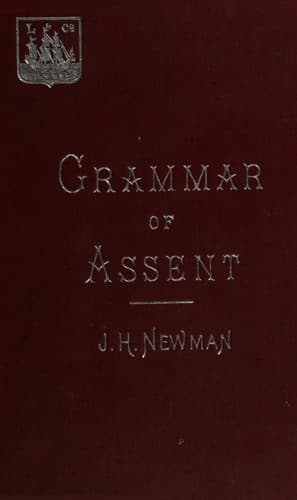
An Essay in Aid of a Grammar of Assent
مقال في مساعدة قواعد الإذعان
Essai pour contribuer à une grammaire de l'assentiment
Editorial summary
Newman's "An Essay in Aid of a Grammar of Assent" presents a sophisticated philosophical defense of religious belief that challenges prevailing empiricist and rationalist epistemologies of the Victorian era. The work argues that genuine certainty in matters of faith emerges not from demonstrative proof but from what Newman terms the "illative sense" - a faculty of judgment that integrates convergent probabilities to reach definitive conclusions about concrete realities, including religious truths.
The essay directly confronts Lockean epistemology and its nineteenth-century inheritors who restrict legitimate belief to propositions supported by formal demonstration or empirical evidence. Against this restrictive framework, Newman contends that most significant human beliefs - from historical facts to moral principles to religious convictions - arise through informal inference rather than syllogistic reasoning. He distinguishes between "notional assent" given to abstract propositions and "real assent" that engages the whole person in response to concrete realities. Religious faith, he maintains, exemplifies real assent par excellence.
Newman's method combines phenomenological analysis of actual belief-formation with historical examples drawn from science, everyday life, and religious experience. He demonstrates that even scientific discoveries often proceed through intuitive leaps validated only retrospectively. The illative sense operates similarly in religious matters, accumulating probabilistic evidence - from conscience, history, scripture, and personal experience - until reaching a threshold where assent becomes not merely reasonable but rationally compelling.
The work's originality lies in its validation of personal judgment in religious epistemology without lapsing into pure subjectivism. Newman argues that the illative sense, while personal, operates according to implicit rational principles accessible to philosophical reflection. His account of conscience as an echo of divine voice provides crucial evidence within this cumulative case for theism.
This essay significantly influenced subsequent Catholic thought on faith and reason, anticipating later personalist philosophies while maintaining dialogue with British empiricism. By defending the rationality of religious belief without reducing faith to logical demonstration, Newman offers a nuanced position between fideism and rationalism. His work remains relevant to contemporary debates about the epistemology of religious belief, particularly discussions of properly basic beliefs and the role of non-propositional evidence in justifying theistic commitment.
Argument formulations engaged
Related works
Newman, John Henry (1870). An Essay in Aid of a Grammar of Assent. University of Notre Dame Press.
@book{an-essay-in-aid-of-a-grammar-of-assent-1,
  author    = {Newman, John Henry},
  title     = {An Essay in Aid of a Grammar of Assent},
  year      = {1870},
  publisher = {University of Notre Dame Press},
  url       = {https://god-database.com/en/works/an-essay-in-aid-of-a-grammar-of-assent-1870}
}