
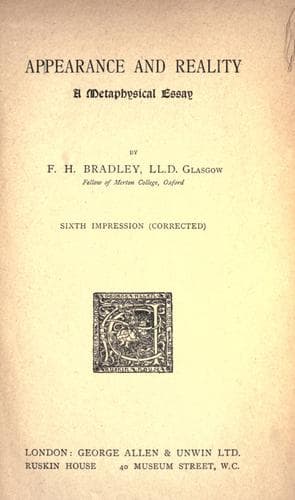
Appearance and Reality
الظاهر والحقيقة
Apparence et réalité
Editorial summary
This philosophical treatise presents one of the most comprehensive idealist metaphysical systems in Western philosophy, with profound implications for understanding the divine and ultimate reality. Bradley develops a radical monistic idealism that dissolves all ordinary distinctions, including that between God and world, into a single all-encompassing Absolute.
The work systematically examines various candidates for ultimate reality, including space, time, causation, things, selves, and even traditional conceptions of God, arguing that each contains internal contradictions when analyzed rigorously. Bradley employs a distinctive dialectical method, showing how every finite category, when pressed to its logical conclusion, reveals itself as merely apparent rather than ultimately real. His famous doctrine holds that all relations are contradictory because they simultaneously connect and separate their terms, leading to infinite regress.
Central to Bradley's argument is the claim that reality must be a single, undifferentiated whole—the Absolute—in which all apparent diversity is somehow harmoniously included while transcending its contradictory appearance. This Absolute bears similarities to certain theological conceptions of God, yet Bradley explicitly rejects personal theism. He argues that conceiving God as a person, standing in relation to creation, subjects the divine to the same contradictions afflicting all relational existence.
The work engages critically with both empiricist philosophy and traditional Christian theology. Against empiricists, Bradley maintains that immediate experience points beyond itself to an absolute reality. Against theologians, he contends that their God remains trapped within the realm of appearance, being merely the highest finite concept rather than the infinite Absolute itself.
Bradley's position significantly influenced subsequent philosophy of religion. His critique of relational theology anticipated process thought, while his notion of the Absolute influenced various forms of religious mysticism and pantheism. The work raises fundamental questions about whether ultimate reality can be personal, whether genuine theism requires a God distinct from the world, and whether religious experience points to something beyond all conceptual formulation.
The text remains significant for contemporary debates about divine simplicity, the relationship between God and world, and the limits of theological language. Bradley's rigorous argument that discursive thought cannot capture ultimate reality challenges both rationalist natural theology and anthropomorphic religious conceptions, suggesting that the divine, if it exists, must transcend all human categories including personality and consciousness as ordinarily understood.
Argument formulations engaged
Related works
Bradley, Francis Herbert (1893). Appearance and Reality.
@book{appearance-and-reality-1893,
  author    = {Bradley, Francis Herbert},
  title     = {Appearance and Reality},
  year      = {1893},
  url       = {https://god-database.com/en/works/appearance-and-reality-1893}
}