
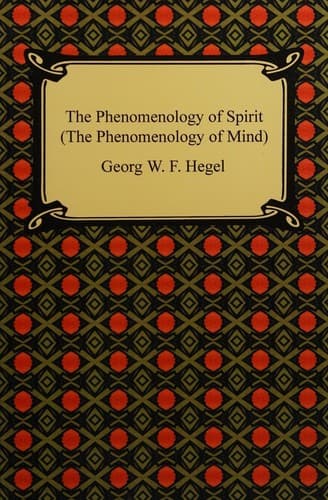
Phenomenology of Spirit
فينومينولوجيا الروح
Phénoménologie de l'esprit
Editorial summary
Hegel's Phenomenology of Spirit presents a revolutionary philosophical system that fundamentally reconceives the relationship between human consciousness and divine reality. The work traces the dialectical development of consciousness from immediate sense-certainty through various stages of self-awareness to absolute knowing, wherein the distinction between finite human consciousness and infinite divine spirit dissolves. For Hegel, God is neither a transcendent being nor a mere projection of human consciousness, but rather the absolute spirit that realizes itself through the historical development of human thought and culture.
The text employs a distinctive phenomenological method that follows consciousness as it encounters and overcomes contradictions in its own understanding. Each stage of consciousness discovers its own inadequacy and transforms into a higher, more comprehensive form. This dialectical progression moves through sense-certainty, perception, understanding, self-consciousness, reason, spirit, religion, and finally absolute knowing. Crucially, Hegel argues that what traditional theology calls God is actually the whole of this developmental process rather than a separate entity existing beyond it.
Against both traditional theism and Enlightenment deism, Hegel contends that divine reality cannot be understood as a being separate from the world and human consciousness. He critiques Kant's limitation of human knowledge, arguing instead that the absolute is knowable precisely through the philosophical comprehension of consciousness's own development. The famous master-slave dialectic demonstrates how self-consciousness emerges through recognition and struggle, while the sections on religion show how humanity's various conceptions of the divine represent stages in spirit's self-understanding rather than mere errors or approximations.
The work's significance for philosophical theology cannot be overstated. It offers a sophisticated alternative to both traditional metaphysical proofs for God's existence and skeptical rejections of religious claims. By identifying God with the rational structure of reality itself as it unfolds in history and consciousness, Hegel provides a framework that seeks to preserve religious insights while transforming them into philosophical comprehension. This approach profoundly influenced subsequent theology, particularly Protestant thought, while also inspiring secular interpretations that read Hegel as ultimately dissolving theology into philosophy. The Phenomenology thus stands as a watershed text that reconceives the divine not as an object of belief but as the subject-object unity achieved in absolute knowing.
Argument formulations engaged
Related works
Hegel, Georg Wilhelm Friedrich (1807). Phenomenology of Spirit. Neeland Media LLC.
@book{phenomenology-of-spirit-1807,
  author    = {Hegel, Georg Wilhelm Friedrich},
  title     = {Phenomenology of Spirit},
  year      = {1807},
  publisher = {Neeland Media LLC},
  url       = {https://god-database.com/en/works/phenomenology-of-spirit-1807}
}