
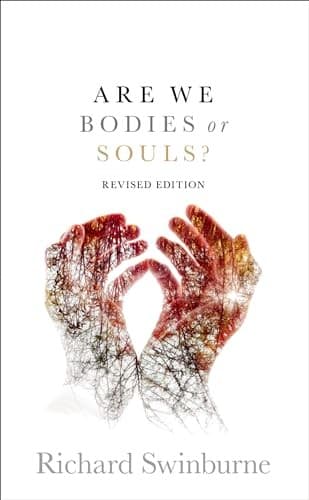
Are We Bodies or Souls?
هل نحن أجساد أم أرواح؟
Sommes-nous des corps ou des âmes ?
Editorial summary
Richard Swinburne's "Are We Bodies or Souls?" presents a systematic defense of substance dualism, arguing that human beings consist of both physical bodies and immaterial souls. The work represents a significant contribution to contemporary philosophy of mind by offering a rigorous philosophical case for the soul's existence while engaging directly with physicalist and materialist alternatives.
Swinburne begins by examining the nature of personal identity, arguing that neither physical continuity nor psychological continuity theories adequately explain what makes a person the same individual over time. He contends that only the existence of an immaterial soul can account for the persistence of personal identity through radical physical and mental changes. The author employs thought experiments, including scenarios involving brain transplants and gradual replacement of neurons, to demonstrate that personal identity cannot be reduced to physical or functional properties.
The work systematically critiques contemporary physicalism, addressing arguments from neuroscience and cognitive science that purport to show consciousness emerges from brain states alone. Swinburne argues that the qualitative nature of conscious experience and the unity of consciousness cannot be explained by physical processes. He maintains that the correlation between brain states and mental states does not establish that the former cause the latter without the mediation of an immaterial soul.
Methodologically, Swinburne combines analytic philosophy with elements of natural theology, drawing on both logical argument and empirical considerations. He engages extensively with contemporary philosophers of mind, including David Chalmers, Daniel Dennett, and Paul Churchland, while also incorporating insights from neuroscience and psychology. The work notably argues that substance dualism provides the most coherent framework for understanding free will, moral responsibility, and the possibility of life after death.
The monograph's significance for the God debate lies in its implications for theistic anthropology. While Swinburne does not make God's existence the central focus, he argues that the existence of souls fits more naturally within a theistic worldview than a naturalistic one. The work suggests that if humans possess immaterial souls that cannot emerge from purely physical processes, this points toward a non-physical source of human consciousness, traditionally identified with divine creation. This argument contributes to cumulative case approaches to theism while challenging naturalistic assumptions about human nature prevalent in contemporary philosophy of mind.
Argument formulations engaged
Related works
Swinburne, Richard (2019). Are We Bodies or Souls?. Oxford University Press.
@book{are-we-bodies-or-souls-2019,
  author    = {Swinburne, Richard},
  title     = {Are We Bodies or Souls?},
  year      = {2019},
  publisher = {Oxford University Press},
  url       = {https://god-database.com/en/works/are-we-bodies-or-souls-2019}
}