
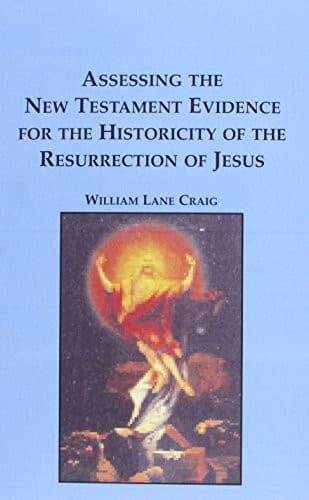
Assessing the New Testament Evidence for the Historicity of the Resurrection of Jesus
تقييم أدلة العهد الجديد لتاريخية قيامة يسوع
Évaluation des preuves du Nouveau Testament pour l'historicité de la résurrection de Jésus
Editorial summary
This monograph presents a rigorous historical investigation of the New Testament accounts concerning Jesus's resurrection, employing the methodological tools of critical historiography to assess their reliability. Craig structures his analysis around three primary lines of evidence: the discovery of the empty tomb, the post-mortem appearances of Jesus, and the origin of the disciples' resurrection belief.
The work engages substantially with the German tradition of New Testament criticism, particularly addressing the skeptical arguments advanced by scholars such as Rudolf Bultmann and Willi Marxsen. Craig challenges the prevailing assumption in much twentieth-century biblical scholarship that the resurrection narratives represent later theological constructions rather than historical reportage. He argues that when standard historiographical criteria are applied—multiple attestation, dissimilarity, embarrassment, and coherence—the core elements of the resurrection accounts demonstrate remarkable historical credibility.
Central to Craig's methodology is his treatment of the biblical texts as historical documents subject to the same analytical scrutiny as other ancient sources. He examines the Gospel accounts alongside Paul's testimony in 1 Corinthians 15, arguing for the early date and independence of these traditions. His analysis of the empty tomb narrative emphasizes factors that would be unlikely in a fabricated account, such as the prominence of women as primary witnesses in a cultural context where female testimony carried little legal weight.
The monograph's significance extends beyond biblical studies to natural theology and philosophy of religion. Craig contends that if the historicity of the resurrection can be established through standard historical methodology, this provides powerful evidence for theism and specifically Christian theism. He addresses naturalistic explanations for the resurrection appearances—hallucination hypotheses, conspiracy theories, and apparent death theories—arguing that each fails to account adequately for the totality of the evidence.
Craig's work represents a sophisticated response to Humean skepticism about miracles by arguing that the historical evidence must be evaluated on its own merits rather than dismissed through prior philosophical commitments to naturalism. The monograph has proven influential in subsequent debates about the relationship between historical investigation and religious belief, challenging the fact-value distinction that often insulates historical Jesus research from theological implications. His approach demonstrates how analytical philosophy and historical-critical methodology can converge in examining religious truth claims.
Argument formulations engaged
Related works
Craig, William Lane (1989). Assessing the New Testament Evidence for the Historicity of the Resurrection of Jesus. Edwin Mellen Press.
@book{assessing-the-new-testament-evidence-for,
  author    = {Craig, William Lane},
  title     = {Assessing the New Testament Evidence for the Historicity of the Resurrection of Jesus},
  year      = {1989},
  publisher = {Edwin Mellen Press},
  url       = {https://god-database.com/en/works/assessing-the-new-testament-evidence-for-the-historicity-of-the-resurrection-of-jesus-1989}
}