
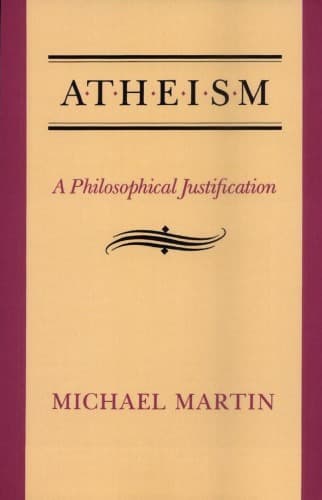
Atheism: A Philosophical Justification
الإلحاد: تبرير فلسفي
Athéisme : Une justification philosophique
Editorial summary
Paul Edwards's "Atheism: A Philosophical Justification" presents a systematic defense of atheism through rigorous philosophical analysis of traditional theistic arguments and concepts. The work represents a significant contribution to late twentieth-century atheistic philosophy, positioning itself against both classical natural theology and modern attempts to rationally ground religious belief.
Edwards structures his argument around two primary strategies: the dismantling of positive reasons for believing in God's existence, and the advancement of compelling reasons for disbelief. He examines classical theistic proofs including cosmological, teleological, and ontological arguments, subjecting each to detailed logical scrutiny. Rather than merely cataloging familiar objections, Edwards develops original criticisms that target the conceptual foundations of these arguments. He pays particular attention to the coherence of the God concept itself, arguing that traditional divine attributes generate insurmountable logical contradictions when analyzed carefully.
The work engages directly with prominent theistic philosophers including Richard Swinburne, Alvin Plantinga, and William Alston, while drawing on the atheistic tradition from David Hume through Bertrand Russell. Edwards employs analytical philosophical methods throughout, combining conceptual analysis with empirical considerations where relevant. His treatment of the problem of evil stands out as particularly thorough, examining both logical and evidential versions while addressing sophisticated theodicies that had emerged in response to earlier atheistic critiques.
A distinctive feature of Edwards's approach involves his sustained attention to the epistemological dimensions of religious belief. He argues that theistic belief fails to meet reasonable standards of evidence and rationality that govern other domains of human knowledge. This epistemological critique extends beyond mere absence of evidence to encompass what Edwards characterizes as positive evidence against theism, particularly regarding divine hiddenness and religious diversity.
The monograph's significance lies not only in its comprehensive scope but in its methodological rigor. Edwards anticipates and addresses potential objections systematically, engaging with the strongest versions of theistic arguments rather than constructing straw men. His work helped establish atheism as a philosophically respectable position requiring serious intellectual engagement, moving beyond mere skepticism toward a positive philosophical stance. The text remains influential in contemporary philosophy of religion, frequently cited in debates about the rationality of religious belief and the burden of proof in theological discussions.
Argument formulations engaged
Related works
Edwards, Paul (1980). Atheism: A Philosophical Justification. Temple University Press.
@book{atheism-a-philosophical-justification-19,
  author    = {Edwards, Paul},
  title     = {Atheism: A Philosophical Justification},
  year      = {1980},
  publisher = {Temple University Press},
  url       = {https://god-database.com/en/works/atheism-a-philosophical-justification-1980}
}