
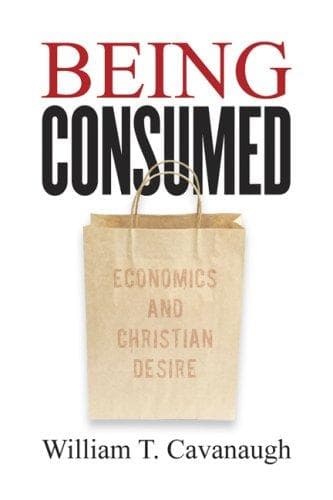
Being Consumed
أن تكون مستهلكاً
Être consumé
Editorial summary
Cavanaugh's Being Consumed examines the theological implications of contemporary consumer culture, arguing that modern economic practices fundamentally shape human desires and spiritual orientations. The work positions itself against both secular market triumphalism and simplistic religious critiques of capitalism, developing instead a nuanced theological analysis of consumption that draws heavily on Augustine's understanding of desire and the Eucharistic tradition.
The monograph proceeds through four interconnected essays addressing freedom, detachment, globalization, and scarcity. Cavanaugh challenges the prevailing notion that free markets necessarily produce genuine freedom, contending that consumer capitalism often generates its own forms of bondage through the manipulation and misdirection of desire. He argues that authentic freedom emerges not from unlimited choice but from properly ordered loves directed toward their true end in God. This Augustinian framework allows him to critique both the anthropology underlying neoliberal economics and the practical effects of consumerism on human flourishing.
Central to Cavanaugh's argument is the claim that consumption practices constitute a form of spiritual discipline that rivals traditional religious formation. He demonstrates how consumer culture cultivates particular dispositions toward material goods, other persons, and ultimate reality itself. Against this backdrop, he presents the Eucharist as an alternative economy that reorders human desires toward communion with God and neighbor. The Eucharistic liturgy, in his reading, schools participants in a different logic of abundance, gift, and participation that resists the competitive individualism of market society.
The work engages critically with both theological and economic literature, drawing on figures ranging from Adam Smith and Milton Friedman to Hans Urs von Balthasar and John Milbank. Cavanaugh's method combines careful conceptual analysis with concrete examples from contemporary business practices and consumer behavior. His theological critique extends beyond mere moralism to address the underlying metaphysical assumptions of economic theory, particularly its truncated understanding of human nature and teleology.
Being Consumed contributes to the God debate by demonstrating how economic practices embody implicit theological claims about human purpose, the nature of desire, and the ultimate good. Cavanaugh argues that consumer capitalism functions as a quasi-religious system that competes with traditional theism for human allegiance. His work suggests that questions about God cannot be adequately addressed without attending to the formative power of economic structures and practices that shape contemporary consciousness and desire.
Argument formulations engaged
Cavanaugh, William (2008). Being Consumed.
@book{being-consumed-2008,
  author    = {Cavanaugh, William},
  title     = {Being Consumed},
  year      = {2008},
  url       = {https://god-database.com/en/works/being-consumed-2008}
}