
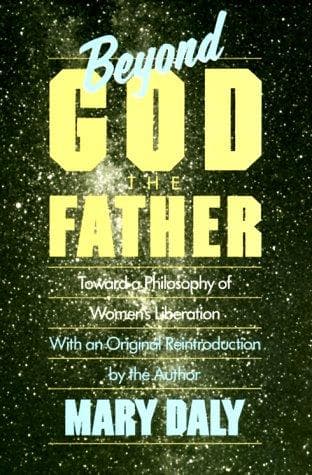
Beyond God the Father
ما وراء الآب الإله
Au-delà de Dieu le Père
Editorial summary
Mary Daly's Beyond God the Father represents a watershed moment in feminist theology and philosophy of religion, fundamentally challenging the patriarchal structures embedded within Christian conceptualizations of divinity. Writing in 1973, Daly argues that traditional theistic language and imagery serve to legitimate and perpetuate male dominance across social, political, and spiritual domains. Her analysis extends beyond mere critique of gendered language to expose how the very concept of God as Father functions as a cornerstone of systemic oppression.
The work employs a method of radical deconstruction, drawing on existentialist philosophy, process thought, and emerging feminist consciousness to dismantle what Daly terms the "patriarchal religion." She contends that the symbol of God as male has operated throughout history to justify women's subordination, arguing that "if God is male, then male is God." This formulation encapsulates her central thesis: that theological symbols possess profound sociological consequences, shaping not merely religious practice but the entire fabric of human relations.
Daly's intellectual context encompasses both her Catholic theological training and her increasing alienation from institutional Christianity. She engages critically with theologians like Paul Tillich and process philosophers while pioneering a distinctly feminist hermeneutic. Her approach combines phenomenological analysis of women's lived experience with systematic critique of theological traditions, from Augustine through Aquinas to contemporary theology.
The monograph's significance lies in its dual movement: deconstructing the God of patriarchal theism while simultaneously pointing toward alternative spiritual possibilities. Daly advocates for moving "beyond God the Father" toward what she terms "Be-ing" - a dynamic, verb-like conception of ultimate reality that transcends static masculine imagery. This reconceptualization aims to liberate both human consciousness and social structures from patriarchal constraints.
Her work profoundly influenced subsequent feminist theology, women's studies, and critical approaches to religion. By demonstrating how traditional God-language functions as a tool of oppression, Daly opened new avenues for theological reflection that take seriously the political dimensions of religious symbolism. The text remains controversial, with critics charging that it abandons Christianity altogether, while supporters celebrate its prophetic challenge to religious and social hierarchies. Daly's analysis inaugurated debates about the relationship between theological language and social justice that continue to shape contemporary discussions about God, gender, and power.
Argument formulations engaged
Daly, Mary (1973). Beyond God the Father. Beacon Press.
@book{beyond-god-the-father-1973,
  author    = {Daly, Mary},
  title     = {Beyond God the Father},
  year      = {1973},
  publisher = {Beacon Press},
  url       = {https://god-database.com/en/works/beyond-god-the-father-1973}
}