
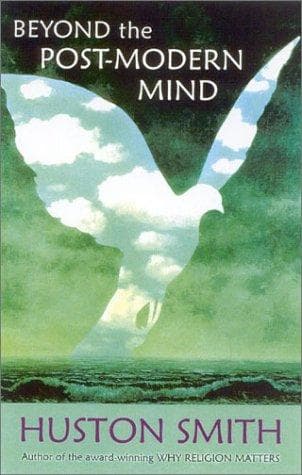
Beyond the Post-Modern Mind
ما وراء العقل ما بعد الحداثي
Au-delà de l'esprit post-moderne
Editorial summary
This monograph represents Huston Smith's critique of postmodern epistemology and his defense of traditional religious worldviews against what he perceives as the reductive tendencies of modern and postmodern thought. Smith argues that postmodernism, while correctly identifying the limitations of scientific materialism, fails to offer a constructive alternative that can accommodate humanity's spiritual dimensions and the transcendent reality affirmed by the world's great religions.
Smith develops his argument through a historical analysis of Western intellectual development, tracing a trajectory from traditional religious cosmologies through modern scientific rationalism to postmodern skepticism. He contends that each phase represents a progressive narrowing of epistemic possibilities, with postmodernism's rejection of metanarratives effectively closing off access to transcendent truth claims. Against this narrative of decline, Smith proposes a "post-postmodern" perspective that recovers the perennial philosophy's insight into hierarchical levels of reality while incorporating legitimate insights from both modern science and postmodern criticism.
The work engages critically with key postmodern thinkers including Derrida, Foucault, and Rorty, arguing that their deconstruction of absolute truth claims inadvertently reinforces a materialist worldview by denying the possibility of genuine spiritual knowledge. Smith particularly challenges the postmodern tendency to reduce religious experience to linguistic constructs or power relations, maintaining that such reductionism ignores the phenomenological reality of mystical encounters across cultures.
Central to Smith's methodology is his comparative approach, drawing on his extensive knowledge of world religions to demonstrate common patterns of spiritual experience and metaphysical understanding that transcend cultural particularities. He employs this cross-cultural evidence to argue for a philosophia perennis that recognizes multiple levels of being, from material to spiritual to divine, each accessible through appropriate modes of knowing.
The monograph's significance lies in its attempt to chart a middle course between fundamentalist rejection of modernity and postmodern dissolution of religious truth claims. Smith advocates for what he terms "primordial tradition," which maintains the reality of transcendent truth while acknowledging the contextual nature of its expression. His work contributes to debates about religious pluralism, the relationship between science and religion, and the possibility of objective spiritual knowledge in a post-Enlightenment context. By defending the cognitive value of religious experience against both scientific materialism and postmodern relativism, Smith offers a sophisticated argument for the continued relevance of traditional metaphysical frameworks in contemporary discourse.
Argument formulations engaged
Smith, Huston (1989). Beyond the Post-Modern Mind.
@book{beyond-the-post-modern-mind-1989,
  author    = {Smith, Huston},
  title     = {Beyond the Post-Modern Mind},
  year      = {1989},
  url       = {https://god-database.com/en/works/beyond-the-post-modern-mind-1989}
}