
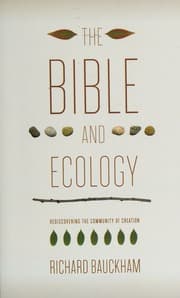
Bible and Ecology: Rediscovering the Community of Creation
الكتاب المقدس والبيئة: إعادة اكتشاف جماعة الخلق
Bible et écologie : Redécouvrir la communauté de la création
Editorial summary
This monograph examines the ecological implications of biblical texts, arguing that Scripture offers profound resources for addressing contemporary environmental crises. Bauckham challenges both anthropocentric readings of the Bible and secular ecological philosophies that dismiss religious perspectives, proposing instead a theocentric vision where creation exists primarily in relation to God rather than humanity.
The work systematically analyzes key biblical passages to demonstrate how Scripture presents creation as an interconnected community of creatures, each possessing intrinsic value before God. Bauckham critiques the influential thesis of Lynn White Jr., who blamed Christianity for ecological destruction, by showing how this interpretation relies on selective and decontextualized readings. Instead, he uncovers biblical themes of human kinship with other creatures, the praise of creation directed toward God, and humanity's role as servant rather than despot.
Central to Bauckham's argument is his treatment of dominion in Genesis 1, which he interprets through the lens of ancient Near Eastern kingship ideology and broader biblical witness. He contends that biblical dominion means careful stewardship and protection rather than exploitation. The work extensively engages Job, Psalms, and wisdom literature to show how these texts decentre humanity and celebrate creation's wild freedom under God's sovereignty.
The monograph's theological method combines careful exegesis with ecological hermeneutics, drawing on contemporary environmental philosophy while maintaining fidelity to biblical thought patterns. Bauckham engages critically with process theology and deep ecology, appreciating their insights while arguing that biblical theocentrism provides a more robust foundation for ecological ethics than either biocentrism or ecocentrism.
The work's significance for the God debate lies in its demonstration that theistic worldviews need not be anthropocentric or ecologically destructive. Against both religious conservatives who prioritize human interests and secular ecologists who view theism as irrelevant or harmful, Bauckham shows how belief in the biblical God can ground radical ecological commitment. His argument that creation's value derives from its relationship to God rather than its usefulness to humans offers a distinctive contribution to environmental ethics.
The monograph influences subsequent ecotheology by establishing biblical interpretation as essential to Christian environmental thought. Its careful scholarship and theological sophistication make it a foundational text for understanding how classical theism can address ecological concerns without abandoning core doctrinal commitments.
Argument formulations engaged
Related works
Bauckham, Richard (2010). Bible and Ecology: Rediscovering the Community of Creation. Baylor University Press.
@book{bible-and-ecology-rediscovering-the-comm,
  author    = {Bauckham, Richard},
  title     = {Bible and Ecology: Rediscovering the Community of Creation},
  year      = {2010},
  publisher = {Baylor University Press},
  url       = {https://god-database.com/en/works/bible-and-ecology-rediscovering-the-community-of-creation-2010}
}