
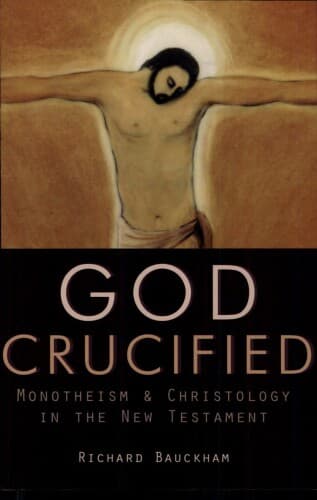
God Crucified: Monotheism and Christology in the New Testament
الله مصلوباً: التوحيد وعلم اللاهوت المسيحي في العهد الجديد
Dieu crucifié : Monothéisme et christologie dans le Nouveau Testament
Editorial summary
This groundbreaking monograph challenges prevailing assumptions about early Christian monotheism and its relationship to Christology. Bauckham argues that the New Testament writers did not compromise Jewish monotheism when attributing divine status to Jesus, but rather included him within the unique identity of the one God of Israel. This thesis directly confronts the dominant scholarly narrative that early Christianity evolved gradually from a low Christology to a high one, moving from Jewish monotheism toward pagan polytheism.
The work centers on Bauckham's innovative concept of "divine identity" rather than "divine nature" as the defining category for Jewish monotheism. He demonstrates that Second Temple Judaism distinguished the one God from all other reality not through abstract attributes but through unique identifying characteristics: God as sole Creator of all things and sovereign Ruler over all things. By meticulously examining key New Testament texts, particularly in Paul and Revelation, Bauckham shows how early Christians consistently portrayed Jesus as participating in these uniquely divine activities—creating and ruling—thereby including him in the divine identity without abandoning monotheism.
The monograph's methodology combines detailed exegesis of New Testament passages with careful analysis of Second Temple Jewish texts, particularly apocalyptic and wisdom literature. Bauckham pays special attention to throne imagery and worship patterns, arguing that Jesus receives worship precisely because he shares the divine throne. His examination of the Shema in 1 Corinthians 8:6 proves particularly influential, showing how Paul reformulates Israel's central monotheistic confession to include both Father and Lord.
This work fundamentally reframes debates about early Christology, moving beyond the tired categories of functional versus ontological Christology. Against scholars who see high Christology as a late Hellenistic development, Bauckham demonstrates its presence from the earliest recoverable stages of the Christian movement. His approach has profound implications for understanding the relationship between Christianity and Judaism, the development of trinitarian theology, and the nature of biblical monotheism itself. The monograph's influence extends across New Testament studies, systematic theology, and Jewish-Christian dialogue, establishing new parameters for discussing how the earliest Christians could worship Jesus while maintaining, in their view, unwavering commitment to the one God of Israel. Bauckham's divine identity Christology has become a dominant paradigm in contemporary scholarship, fundamentally altering how scholars approach the emergence of Christian doctrine about God.
Argument formulations engaged
Related works
Bauckham, Richard (1998). God Crucified: Monotheism and Christology in the New Testament. Eerdmans.
@book{god-crucified-monotheism-and-christology,
  author    = {Bauckham, Richard},
  title     = {God Crucified: Monotheism and Christology in the New Testament},
  year      = {1998},
  publisher = {Eerdmans},
  url       = {https://god-database.com/en/works/god-crucified-monotheism-and-christology-in-the-new-testament-1998}
}