
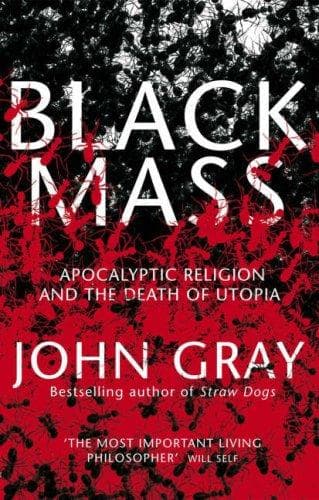
Black Mass: Apocalyptic Religion and the Death of Utopia
القداس الأسود: الدين الجليل وموت اليوتوبيا
Messe noire : Religion apocalyptique et la mort de l'utopie
Editorial summary
John Gray's Black Mass examines the dangerous persistence of apocalyptic thinking in modern secular politics, arguing that contemporary utopian ideologies represent a transformation rather than transcendence of religious impulses. Gray contends that the Enlightenment project of replacing religious faith with reason has failed, producing instead what he terms "political religions" that retain the eschatological structure of Christianity while abandoning its metaphysical restraints.
The work traces how Christian apocalypticism, with its vision of history moving toward a final transformation of human existence, migrated into secular political movements. Gray demonstrates that revolutionary ideologies from Jacobinism through Marxism to neoconservatism share a millenarian structure: they posit an evil to be destroyed, promise radical transformation of the human condition, and justify present violence through future perfection. This analysis extends to liberal interventionism and the "war on terror," which Gray presents as contemporary manifestations of apocalyptic faith seeking to remake the world through force.
Central to Gray's argument is his critique of progress as a secularized version of Christian providence. He argues that belief in inevitable moral and political advancement represents a faith claim unsupported by historical evidence. Unlike scientific knowledge, which accumulates, ethical and political gains prove reversible. Gray draws on conservative thinkers like Joseph de Maistre and philosophical pessimists such as Schopenhauer to challenge progressive narratives, while incorporating insights from value pluralism and critiques of the Enlightenment project.
The work engages critically with new atheist writings, particularly those advocating secular humanism as religion's replacement. Gray argues these positions reproduce Christianity's anthropocentrism and faith in human perfectibility without its tragic awareness of limitation. His analysis suggests that attempts to eliminate religion through reason paradoxically generate more dangerous forms of faith. This critique extends to liberal universalism, which Gray presents as another variant of monotheistic thinking imposing singular values on plural human cultures.
Gray's contribution lies in exposing continuities between religious and ostensibly secular apocalypticism, challenging both progressive narratives and confident secularization theories. His work complicates simple oppositions between faith and reason, suggesting that modern politics remains thoroughly saturated with transformed religious categories. This analysis offers crucial insights for understanding how theological structures persist within supposedly post-religious ideologies, making it essential reading for those examining the relationship between religious thought and political action.
Argument formulations engaged
Related works
Gray, John (2007). Black Mass: Apocalyptic Religion and the Death of Utopia. Allen Lane.
@book{black-mass-apocalyptic-religion-and-the-,
  author    = {Gray, John},
  title     = {Black Mass: Apocalyptic Religion and the Death of Utopia},
  year      = {2007},
  publisher = {Allen Lane},
  url       = {https://god-database.com/en/works/black-mass-apocalyptic-religion-and-the-death-of-utopia-2007}
}