
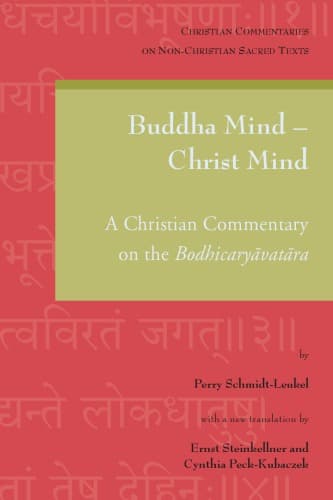
Buddha Mind - Christ Mind
عقل بوذا - عقل المسيح
Esprit de Bouddha - Esprit du Christ
Editorial summary
This monograph examines the convergent spiritual experiences of enlightenment in Buddhism and mystical union in Christianity, arguing that both traditions ultimately point toward the same transcendent reality. Schmidt-Leukel develops a sophisticated comparative theological framework that challenges exclusivist interpretations while maintaining the distinctive features of each tradition.
The work employs a phenomenological and hermeneutical approach, analyzing contemplative texts and practices from both traditions to identify structural parallels in their highest spiritual realizations. Schmidt-Leukel draws particularly on Mahayana Buddhist sources and Christian mystical writings from figures such as Meister Eckhart and John of the Cross. He argues that the Buddhist concept of Buddha-nature and the Christian notion of divine indwelling represent complementary perspectives on ultimate reality rather than contradictory claims.
Central to the argument is Schmidt-Leukel's analysis of consciousness transformation in both traditions. He demonstrates how Buddhist enlightenment and Christian mystical union involve similar processes of ego-transcendence and recognition of a deeper, non-dual awareness. This comparison extends to ethical implications, showing how both paths emphasize compassion and selfless love as natural expressions of spiritual realization.
The monograph directly challenges religious exclusivists who maintain that Buddhism and Christianity are fundamentally incompatible worldviews. Schmidt-Leukel critiques both Christian theologians who dismiss Buddhism as nihilistic and Buddhist philosophers who reject theistic language as necessarily dualistic. Instead, he proposes a model of "reciprocal illumination" where each tradition enriches understanding of the other.
Schmidt-Leukel's contribution to the God debate lies in his sophisticated treatment of how different religious languages can point to the same ultimate reality. He argues that the apparent contradiction between Buddhist non-theism and Christian theism dissolves when one recognizes that both traditions employ apophatic strategies that ultimately transcend conceptual categories. The Buddha's silence on metaphysical questions and the Christian mystical tradition's via negativa are presented as parallel approaches to the ineffable.
The work advances interfaith dialogue by providing philosophical tools for understanding religious diversity without relativism. Schmidt-Leukel maintains that while interpretive frameworks differ, the transformative experiences at the heart of both traditions share essential features. This position offers a middle path between naive syncretism and rigid exclusivism, contributing significantly to contemporary discussions about religious pluralism and the nature of ultimate reality.
Argument formulations engaged
Schmidt-Leukel, Perry (2019). Buddha Mind - Christ Mind. Peeters Publishers.
@book{buddha-mind-christ-mind-2019,
  author    = {Schmidt-Leukel, Perry},
  title     = {Buddha Mind - Christ Mind},
  year      = {2019},
  publisher = {Peeters Publishers},
  url       = {https://god-database.com/en/works/buddha-mind-christ-mind-2019}
}