
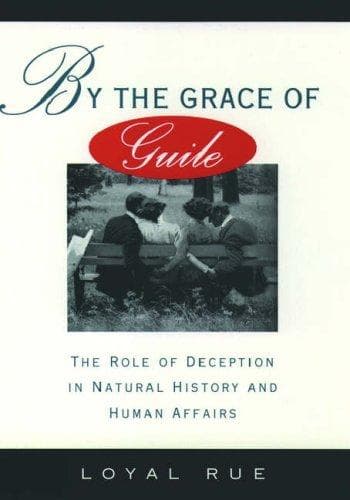
By the Grace of Guile: The Role of Deception in Natural History and Human Affairs
بفضل الحيلة: دور الخداع في التاريخ الطبيعي والشؤون الإنسانية
Par la grâce de la ruse : Le rôle de la tromperie dans l'histoire naturelle et les affaires humaines
Editorial summary
This monograph examines the evolutionary origins and functions of deception across biological systems, ultimately arguing that human religious and philosophical beliefs constitute adaptive illusions necessary for survival. Rue develops a naturalistic framework that traces deception from basic biological mimicry through to complex human meaning systems, including religious narratives about ultimate reality.
The work begins by establishing deception as a fundamental strategy in natural history, documenting how organisms from viruses to primates employ various forms of guile for survival advantage. Rue demonstrates that deceptive capacities increase with neurological complexity, reaching their apex in human self-deception and collective myth-making. This biological foundation serves as the basis for his more controversial thesis: that human beliefs about meaning, purpose, and transcendence represent evolutionarily advantageous falsehoods rather than truth claims.
Central to Rue's argument is the concept of the "noble lie" - the idea that certain illusions prove more adaptive than truth when they promote personal wholeness and social coherence. He contends that purely naturalistic worldviews, while intellectually honest, fail to provide the motivational and social resources necessary for human flourishing. Religious and philosophical systems that posit objective meaning, inherent value, and ultimate purpose better serve human psychological and social needs, even if these systems lack correspondence with reality.
The work engages critically with both scientific naturalism and traditional religious thought. Against religious believers, Rue maintains that naturalistic explanations fully account for the emergence and persistence of religious belief without recourse to supernatural realities. Against fellow naturalists, he argues that truth-telling proves maladaptive when it undermines the illusions necessary for meaningful human existence. This positions him as advocating for a kind of pragmatic nihilism - acknowledging the absence of inherent meaning while endorsing the cultivation of meaningful illusions.
Rue's contribution to debates about God lies in his attempt to preserve the functional value of religious belief while denying its truth value. He suggests that the question of God's existence matters less than the psychological and social utility of God-belief. This pragmatist approach challenges both atheists who dismiss religion entirely and theists who insist on the factual truth of their claims. The work raises profound questions about the relationship between truth, survival, and human flourishing in a godless universe.
Argument formulations engaged
Rue, Loyal (1994). By the Grace of Guile: The Role of Deception in Natural History and Human Affairs.
@book{by-the-grace-of-guile-the-role-of-decept,
  author    = {Rue, Loyal},
  title     = {By the Grace of Guile: The Role of Deception in Natural History and Human Affairs},
  year      = {1994},
  url       = {https://god-database.com/en/works/by-the-grace-of-guile-the-role-of-deception-in-natural-history-and-human-affairs-1994}
}