
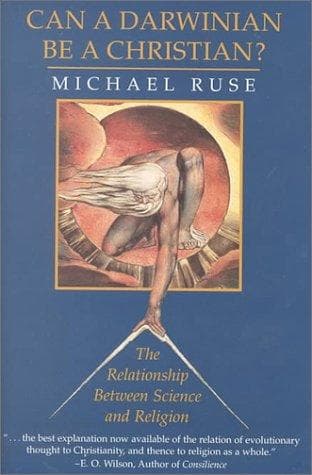
Can a Darwinian be a Christian? The Relationship between Science and Religion
هل يمكن للداروني أن يكون مسيحياً؟ العلاقة بين العلم والدين
Un darwinien peut-il être chrétien ? La relation entre science et religion
Editorial summary
This monograph examines whether evolutionary theory and Christian faith can coexist coherently in a single worldview. Michael Ruse, a philosopher of science and self-described agnostic, offers a nuanced exploration of the compatibility between Darwinian evolution and Christian theology. The work systematically addresses major points of potential conflict, including natural selection's challenge to design arguments, the problem of evil in nature, and questions about human uniqueness and morality.
Ruse structures his analysis around specific theological doctrines, examining how each might accommodate or resist evolutionary explanations. He argues that while some traditional Christian beliefs require modification in light of Darwin, the core commitments of Christianity need not be abandoned. The author distinguishes between different interpretations of Christianity, noting that literalist readings of scripture face greater challenges than more liberal theological positions. He particularly emphasizes that natural selection does not necessarily eliminate purpose or meaning from the universe, as some atheistic interpreters claim.
The work engages extensively with both historical and contemporary figures in the science-religion dialogue. Ruse critiques Richard Dawkins and other scientific materialists who argue that Darwinism necessarily leads to atheism, while also challenging creationists and intelligent design theorists who reject evolutionary science. He draws on theological resources from Augustine to contemporary process theologians, demonstrating how Christian thinkers have historically adapted to new scientific discoveries.
Methodologically, Ruse employs philosophical analysis to clarify conceptual confusions that often plague science-religion discussions. He distinguishes between scientific claims about mechanisms and metaphysical claims about ultimate reality, arguing that conflating these levels of explanation generates unnecessary conflicts. The author also incorporates historical case studies showing how Victorian Christians initially responded to Darwin, revealing that the warfare narrative between science and religion oversimplifies a more complex historical reality.
The monograph's significance lies in its moderate position within polarized debates. Against both scientific atheists and religious fundamentalists, Ruse demonstrates that accepting evolutionary science need not entail rejecting religious belief. His careful philosophical distinctions help readers navigate between simplistic compatibilism and unnecessary conflict. While Ruse personally remains agnostic, his sympathetic treatment of how a rational person might hold both Darwinian and Christian commitments provides valuable resources for believers struggling with scientific challenges to faith, as well as for anyone seeking to understand the logical geography of the science-religion relationship.
Argument formulations engaged
Related works
Ruse, Michael (2001). Can a Darwinian be a Christian? The Relationship between Science and Religion. Cambridge University Press.
@book{can-a-darwinian-be-a-christian-the-relat,
  author    = {Ruse, Michael},
  title     = {Can a Darwinian be a Christian? The Relationship between Science and Religion},
  year      = {2001},
  publisher = {Cambridge University Press},
  url       = {https://god-database.com/en/works/can-a-darwinian-be-a-christian-the-relationship-between-science-and-religion-2001}
}