
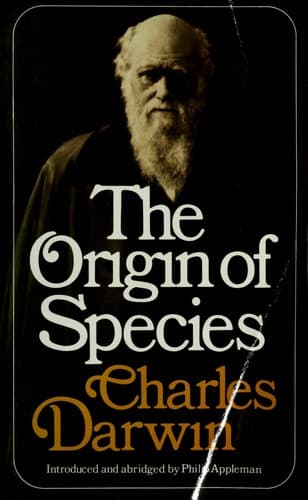
On the Origin of Species
في أصل الأنواع
De l'origine des espèces
The diversity and apparent design of living organisms are best explained not by divine creation but by the natural mechanism of descent with modification through variation and natural selection.
Editorial summary
Darwin's "On the Origin of Species" presents a comprehensive theory of biological evolution through natural selection, fundamentally reshaping debates about divine design in nature. While the work itself focuses on scientific explanation rather than theological argumentation, its implications for traditional design arguments prove transformative for subsequent discussions about God's relationship to the natural world.
The monograph develops its case through meticulous empirical observation and theoretical synthesis. Darwin examines variation under domestication, struggle for existence, and geographical distribution of species, building toward his central mechanism of natural selection. This process, he argues, produces the appearance of design through purely natural means: organisms possessing advantageous variations survive and reproduce more successfully, passing these traits to offspring. Over vast timescales, this simple algorithm generates the complex adaptations that previous natural theologians attributed to divine craftsmanship.
Darwin's methodology combines extensive fieldwork, particularly from his Beagle voyage, with careful analysis of breeding practices and biogeographical patterns. He deliberately adopts a cautious, evidence-based approach, acknowledging difficulties while systematically addressing potential objections. This scientific rigor distinguishes his work from speculative evolutionary theories proposed by earlier thinkers like Lamarck or his grandfather Erasmus Darwin.
The work's significance for the God debate emerges primarily through its challenge to William Paley's watchmaker argument and similar design-based natural theology. Where Paley saw the intricate functionality of organisms as evidence of an intelligent designer, Darwin provides a naturalistic explanation for the same phenomena. The eye, that favorite example of irreducible complexity, becomes comprehensible as the product of gradual modification from simple light-sensitive spots.
Darwin himself maintains strategic silence on ultimate theological questions, limiting his discussion to secondary causes while acknowledging a possible role for primary causation. This reticence reflects both personal uncertainty and pragmatic awareness of his theory's controversial implications. Nevertheless, his framework fundamentally alters the conceptual landscape for subsequent theological discourse, forcing religious thinkers to reconsider how divine action might relate to natural processes.
The work's enduring contribution lies not in explicit atheistic argumentation but in providing a scientifically robust alternative to design-based theism. By explaining biological complexity without recourse to supernatural intervention, Darwin's theory becomes a cornerstone for naturalistic worldviews while simultaneously inspiring new theological approaches that attempt to integrate evolution with divine purpose.
Structured analysis
Argument formulations engaged
Related works
Darwin, Charles (1859). On the Origin of Species.
@book{on-the-origin-of-species,
  author    = {Darwin, Charles},
  title     = {On the Origin of Species},
  year      = {1859},
  url       = {https://god-database.com/en/works/on-the-origin-of-species}
}