
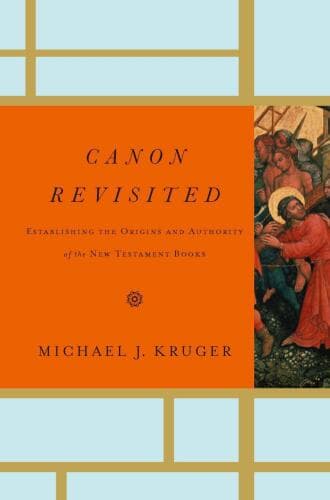
Canon Revisited: Establishing the Origins and Authority of the New Testament Books
إعادة النظر في القانون: تأسيس أصول وسلطة كتب العهد الجديد
Canon revisité : Établir les origines et l'autorité des livres du Nouveau Testament
Editorial summary
This monograph addresses a fundamental challenge to Christian epistemology: the criterion problem as applied to biblical canonicity. Kruger examines how Christians can know which books rightfully belong in the New Testament canon without falling into circular reasoning or infinite regress. The work responds to critical scholarship that portrays canon formation as arbitrary ecclesiastical politics, arguing instead for an intrinsic theological model of canonicity.
Kruger develops what he terms a "self-authenticating" model of canon, positioning it between two inadequate alternatives: the community-determined model (where church authority establishes canon) and the historically-determined model (where modern scholarship reconstructs original canonicity). His approach draws from Reformed epistemology, particularly the concept of properly basic beliefs, to argue that canonical books possess inherent divine qualities recognizable to Spirit-illumined believers. This model suggests Scripture authenticates itself through three interconnected attributes: providential exposure (the books' preservation and transmission), corporate reception (universal church recognition), and internal testimony (the books' self-attesting divine qualities).
The work engages extensively with contemporary canon critics, particularly those who view the canon as a late ecclesiastical imposition disconnected from apostolic Christianity. Kruger counters by demonstrating early canonical consciousness, showing how second-century Christians already operated with functional canonical categories. He argues that recognizing canon differs fundamentally from creating canon—the church discovers rather than determines which books bear divine authority.
Methodologically, Kruger combines historical analysis with theological reflection, examining patristic sources while maintaining explicit Reformed theological commitments. His approach challenges both liberal historical criticism that reduces canon to human politics and fundamentalist fideism that ignores historical process. The work particularly addresses the epistemological anxiety many Christians experience when confronted with critical scholarship's deconstruction of biblical authority.
The monograph's significance extends beyond technical canon studies to broader questions about religious knowledge and divine revelation. By providing a philosophically sophisticated account of how Christians can rationally maintain confidence in their Scripture's boundaries, Kruger offers a model for how religious communities might ground their foundational texts without appealing to bare authority or circular reasoning. His self-authenticating model represents an important contribution to Reformed epistemology's engagement with biblical criticism, demonstrating how theological convictions about divine action can integrate with serious historical scholarship.
Argument formulations engaged
Kruger, Michael J. (2012). Canon Revisited: Establishing the Origins and Authority of the New Testament Books. Crossway.
@book{canon-revisited-establishing-the-origins,
  author    = {Kruger, Michael J.},
  title     = {Canon Revisited: Establishing the Origins and Authority of the New Testament Books},
  year      = {2012},
  publisher = {Crossway},
  url       = {https://god-database.com/en/works/canon-revisited-establishing-the-origins-and-authority-of-the-new-testament-books-2012}
}