
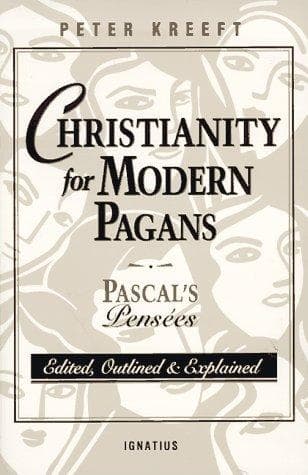
Christianity for Modern Pagans: Pascal's Pensées Edited, Outlined, and Explained
المسيحية للوثنيين المعاصرين: خواطر باسكال محررة ومفصلة ومشروحة
Le christianisme pour les païens modernes : Les Pensées de Pascal éditées, esquissées et expliquées
Editorial summary
Peter Kreeft's Christianity for Modern Pagans presents a systematic reconstruction of Pascal's fragmentary Pensées, offering contemporary readers an accessible entry point into one of the most influential apologetic works in Christian philosophy. Kreeft organizes Pascal's scattered fragments into a coherent argumentative structure while providing extensive commentary that bridges seventeenth-century French Catholic thought with late twentieth-century concerns.
The work centers on Pascal's wager and his broader apologetic strategy, which Kreeft frames as uniquely suited to address modern secular consciousness. Unlike traditional scholastic proofs for God's existence, Pascal's approach begins with psychological and existential analysis of the human condition. Kreeft emphasizes how Pascal diagnoses humanity's simultaneous wretchedness and greatness, arguing that only Christian revelation adequately explains this paradox. The human heart's infinite longing, coupled with finite dissatisfaction, points toward a transcendent fulfillment that Pascal identifies with the Christian God.
Kreeft's commentary highlights Pascal's critique of both rationalist philosophy and fideistic anti-intellectualism. Against Descartes and the emerging Enlightenment confidence in autonomous reason, Pascal argues that the heart has reasons that reason cannot grasp. Yet against mere sentimentalism, he maintains that faith must satisfy intellectual integrity. This balance positions Pascal as a precursor to existentialist themes while remaining firmly within orthodox Catholic theology.
The editorial apparatus serves multiple functions. Kreeft provides historical context for Pascal's engagement with Jansenism, Jesuit moral theology, and the libertine culture of his era. He draws parallels between seventeenth-century skeptics and contemporary secular materialism, suggesting that Pascal's psychological insights remain remarkably prescient. The commentary also addresses standard objections to the wager argument, defending it against charges of cynical calculation by situating it within Pascal's broader phenomenology of human desire.
Kreeft's arrangement transforms the Pensées from a collection of brilliant but disconnected insights into a sustained case for Christian faith. While some scholars criticize any attempt to systematize Pascal's intentionally fragmentary style, Kreeft argues that Pascal himself intended a more structured apologetic work. The result functions both as an introduction to Pascal's thought and as an independent contribution to contemporary Christian apologetics, demonstrating how classical arguments can address perennial human questions about meaning, mortality, and transcendence.
Argument formulations engaged
Related works
Kreeft, Peter (1993). Christianity for Modern Pagans: Pascal's Pensées Edited, Outlined, and Explained. Ignatius Press.
@book{christianity-for-modern-pagans-pascals-p,
  author    = {Kreeft, Peter},
  title     = {Christianity for Modern Pagans: Pascal's Pensées Edited, Outlined, and Explained},
  year      = {1993},
  publisher = {Ignatius Press},
  url       = {https://god-database.com/en/works/christianity-for-modern-pagans-pascals-pens-es-edited-outlined-and-explained-1993}
}