
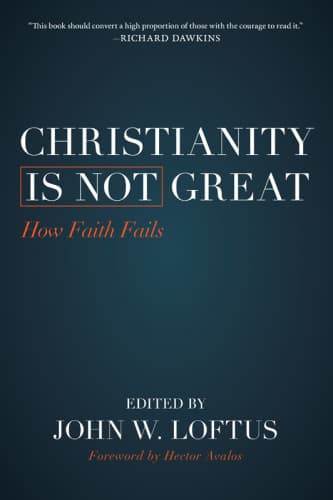
Christianity Is Not Great: How Faith Fails
المسيحية ليست عظيمة: كيف يفشل الإيمان
Le christianisme n'est pas formidable : Comment la foi échoue
Editorial summary
This volume assembles critical examinations of Christianity's historical and contemporary failures across multiple domains, arguing that religious faith produces demonstrable harm rather than benefit to human flourishing. Editor John W. Loftus, a former evangelical minister turned atheist activist, structures the collection as a systematic indictment of Christianity's truth claims and social impact, positioning the work as a companion to atheist critiques of religion more broadly.
The contributors employ diverse methodological approaches, from historical analysis to psychological research, to document Christianity's negative effects. Essays examine the religion's role in perpetuating violence, from the Crusades to contemporary terrorism, its opposition to scientific progress, particularly in medicine and biology, and its reinforcement of harmful social hierarchies regarding gender, sexuality, and race. Several chapters focus on Christianity's psychological impact, arguing that religious belief systems foster cognitive distortions, emotional manipulation, and impediments to critical thinking. The volume particularly emphasizes Christianity's resistance to moral progress, documenting how biblical literalism and religious authority have historically opposed advances in human rights and social justice.
Loftus frames this critique within the broader New Atheist movement, explicitly building on works by Richard Dawkins, Christopher Hitchens, and Sam Harris while focusing specifically on Christianity rather than religion generally. The collection responds to Christian apologists who argue that their faith represents a force for good in the world, countering with empirical evidence of harm. Contributors include former believers alongside secular academics, lending the volume both insider knowledge and scholarly distance.
The work's significance lies in its comprehensive scope and accessible presentation of anti-religious arguments. Rather than focusing solely on philosophical problems with theism or biblical contradictions, the volume emphasizes practical consequences, making the case that Christianity fails not merely as a truth claim but as a beneficial social institution. This approach reflects a strategic shift in atheist discourse from abstract theological debates to concrete social criticism. The collection serves both as a resource for atheist activism and as a systematic presentation of Christianity's critics' strongest empirical arguments, contributing to ongoing debates about religion's proper role in contemporary society.
Argument formulations engaged
Related works
Loftus, John W. (2014). Christianity Is Not Great: How Faith Fails. Prometheus Books.
@book{christianity-is-not-great-how-faith-fail,
  author    = {Loftus, John W.},
  title     = {Christianity Is Not Great: How Faith Fails},
  year      = {2014},
  publisher = {Prometheus Books},
  url       = {https://god-database.com/en/works/christianity-is-not-great-how-faith-fails-2014}
}